


2. Department of Master's Program in Neurology, Faculty of Medicine, College of Medicine, Kaohsiung Medical University Hospital, Kaohsiung, Taiwan, China;
3. Department of Neurology, Kaohsiung Municipal Ta-Tung Hospital, Kaohsiung, Taiwan, China
The apolipoprotein E (APOE) ε4 allelle is a well-established risk factor for cognitive decline. Racial factors may mitigate its effects. However, APOE ε4 has similar effects even among different racial groups. The APOE genotype in patients with Alzheimer's disease may influence therapeutic decisions.
1 Introduction
Alzheimer’s disease (AD) is a neurodegenerative disease with progressive loss of neuronal functions, which in turn results in memory deficits,cognitive deterioration,and impaired motor coordination. The increase in the aging population has led to an increasing prevalence of AD. However,no existing treatment can effectively halt the progression or prevent the onset of AD. AD is characterized neuropathologically by two hallmarks: intra‐neuronal neurofibrillary tangles and amyloid plaques[1]. The major factor associated with AD is aging,with family history playing an important secondary role. However, another common risk factor for AD is the ε4 allele of the apolipoprotein E (APOE) gene[2, 3, 4].
The APOE gene is localized on chromosome 19 and comprises three major alleles (ε2,ε3,and ε4). Of these alleles,ε4 has been identified as a genetic risk factor for AD[5]. Carriers have a higher risk with two APOE ε4 alleles (ε4/ε4)[6]. APOE ε4 is considered as a biomarker for the preclinical stage of AD[7]. In 2002,Lange et al. found that the APOE genotype had little effect on the rate of memory decline[8]. However,the results of most research studies tend to suggest that APOE ε4 is commonly associated with age‐related cognitive decline[9, 10]. Although APOE ε4 is generally suggested to play a role in the onset of AD,the mechanism through which it exerts this effect remains unclear. Potential mechanisms include affecting amyloid‐beta (Aβ) deposition and clearance,or playing a probable regulatory role in tau phosphorylation[11, 12, 13]. Furthermore, most studies on the association of APOE with memory impairment have demonstrated significantly greater decline in memory in APOE ε4 carriers to no APOE ε4 carriers. APOE ε4 carriers have exhibited particularly impaired verbal and visual memory[14, 15]. However,APOE ε4 is not only related to the acceleration of Aβ deposition,but also to hippocampal atrophy and default mode network dysfunction[1],and other processes may be affected as well.
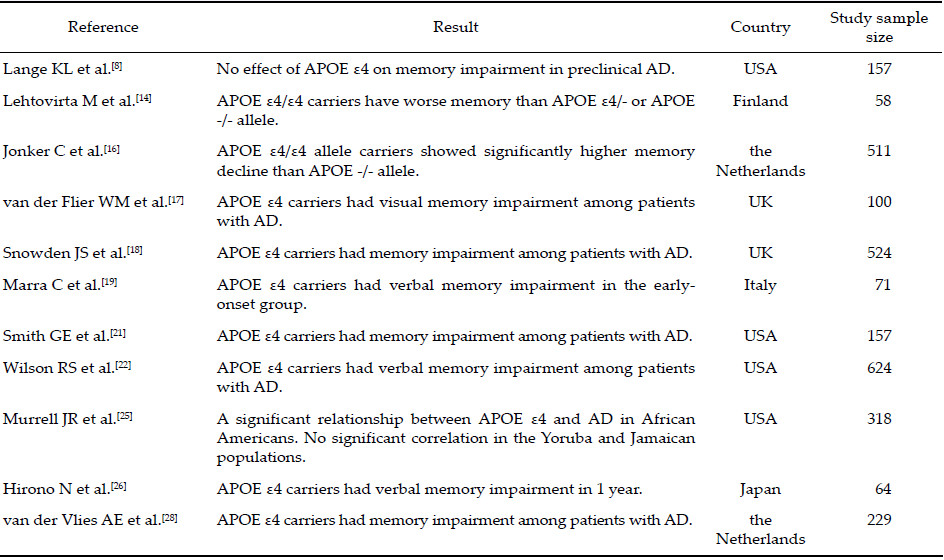
2 Effect of racial differences in APOE on cognitive outcomeAD risk factors have not been thoroughly studied in different ethnicities and populations. There is evidence that these risk factors may vary considerably among ethnic groups. Table 1 summarizes the results of APOE ε4‐related studies examining different racial populations[29]. Studies in Finland[14],the Netherlands[16], United Kingdom[17, 18],and Italy[19] have found APOE ε4 to be associated with cognitive decline. The APOE ε4 allele is especially common among people of European ancestry[20]. Several studies from the United States have reported similar conclusions[8, 15, 21, 22]. More specifically,The APOE ε4 allele is also common among people of African ancestry[23]. Some studies suggest that APOE ε4 has a weaker relationship with cognitive decline in this population[23],whereas other studies have suggested the opposite[24, 25]. Table 1 show that a lower number of studies were conducted in Asia. In Japan,population‐based studies of white and Japanese populations have found that the APOE ε4/ε4 genotype is associated with a significantly increased risk of AD[26]. Few studies have investigated this relationship in the population of China.
 |
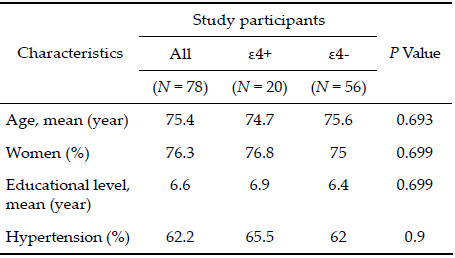
In 2015,Yang et al. published the first analysis of the relationship between the APOE ε4 genotype and treatment responses in the patients with AD in Taiwan, reporting that APOE ε4‐positive (i.e.,having at least one APOE ε4 allele) patients with AD exhibited more rapid functional decline despite treatment[27]. However, this study had some limitations,including a relatively small sample size. Our study expanded these findings. In order to have a more clear understanding of the association of the therapeutic response and APOE ε4 genotype,we have analyzed 78 more patients with AD in Taiwan of whom 26.3% had the APOE ε4‐positive gene,by using one‐way ANOVA (Table 2) and controlling other possible variables[27]. The average age of patients was 75.4 years. The APOE ε4 gene carriers were younger than non‐carriers and had a higher education level (Table 2). Of these 78 patients,62.2% had hypertension. No significant difference in cognitive resilience was observed between patients with differing APOE ε4 status,age,sex,education level,or hypertension status.
 |
The heterogeneous results for the association of therapeutic outcomes and APOE ε4 genotype in published studies might be the result of differences in the study designs,psychometrics used,and races.
Although our study yielded nonsignificant results, above mentioned studies have been limited by various methodological problems including small sample size,corrected detection and analysis methods,and dichotomous measures of cognitive functioning. Furthermore,nongenetic differences,such as lifestyle and dietary factors,may also affect the results. The potential for cognitive resilience was not significant in the fully adjusted models. Considering the different results of the two studies in the population in Taiwan evaluating the therapeutic response of APOE ε4 genotype in patients with AD,the detailed mechanisms and other variables related to the therapeutic response should be clarified.
APOE testing warrants further research for the development of a screening method for the APOE gene across different races. APOE genotype could be a clinical biomarker similar to amyloid plaques and hyperphosphorylated tau proteins. Such studies on the racial differences in APOE could lead to interventions aimed at high‐risk groups. These studies can aid in developing ways to promote cognitive resilience among APOE ε4 carriers of different racial backgrounds.
Conflict of interestsThe authors have no financial interest to disclose regarding the article.
| [1] | Wenk GL. Neuropathologic changes in Alzheimer's disease. J Clin Psychiatry 2003, 64(Suppl 9): 7-10. |
| Click to display the text | |
| [2] | Corder EH, Saunders AM, Strittmatter WJ, Schmechel DE, Gaskell PC, Small GW, Roses AD, Haines JL, Pericak-Vance MA. Gene dose of apolipoprotein E type 4 allele and the risk of Alzheimer's disease in late onset families. Science 1993, 261(5123): 921-923. |
| Click to display the text | |
| [3] | Roses AD. Apolipoprotein E affects the rate of Alzheimer disease expression: β-amyloid burden is a secondary consequence dependent on APOE genotype and duration of disease. J Neuropathol Exp Neurol 1994, 53(5): 429-437. |
| Click to display the text | |
| [4] | Strittmatter WJ, Saunders AM, Schmechel D, Pericak-Vance M, Enghild J, Salvesen GS, Roses AD. Apolipoprotein E: High-avidity binding to beta-amyloid and increased frequency of type 4 allele in late-onset familial Alzheimer disease. Proc Natl Acad Sci USA 1993, 90(5): 1977-1981. |
| Click to display the text | |
| [5] | Farrer LA, Cupples LA, Haines JL, Hyman B, Kukull WA, Mayeux R, Myers RH, Pericak-Vance MA, Risch N, van Duijn CM. Effects of age, sex, and ethnicity on the association between apolipoprotein E genotype and Alzheimer disease. A meta-analysis. JAMA 1997, 278(16): 1349-1356. |
| Click to display the text | |
| [6] | Davidson Y, Gibbons L, Pritchard A, Hardicre J, Wren J, Stopford C, Julien C, Thompson J, Payton A, Pickering-Brown SM, Pendleton N, Horan MA, Burns A, Purandare N, Lendon CL, Neary D, Snowden JS, Mann DMA. Apolipoprotein E ε4 allele frequency and age at onset of Alzheimer's disease. Dement Geriatr Cogn Disord 2007, 23(1): 60-66. |
| Click to display the text | |
| [7] | Resnick SM, Bilgel M, Moghekar A, An Y, Cai Q, Wang MC, Thambisetty M, Prince JL, Zhou Y, Soldan A, Wong DF, O'Brien RJ, Ferrucci L, Albert MS. Changes in Aβ biomarkers and associations with APOE genotype in 2 longitudinal cohorts. Neurobiol Aging 2015, 36(8): 2333-2339. |
| Click to display the text | |
| [8] | Lange KL, Bondi MW, Salmon DP, Galasko D, Delis DC, Thomas RG, Thal LJ. Decline in verbal memory during preclinical Alzheimer's disease: Examination of the effect of APOE genotype. J Int NeuropsycholSoc 2002, 8(7): 943-955. |
| Click to display the text | |
| [9] | Wisdom NM, Callahan JL, Hawkins KA. The effects of apolipoprotein E on non-impaired cognitive functioning: A meta-analysis. Neurobiol Aging 2011, 32(1): 63-74. |
| Click to display the text | |
| [10] | Thorvaldsson V, Nordlund A, Reinvang I, Blennow K, Zetterberg H, Wallin A, Johansson B. Memory in individuals with mild cognitive impairment in relation to APOE and CSF Aβ42. Int Psychogeriatr 2010, 22(4): 598-606. |
| Click to display the text | |
| [11] | Hardy J, Allsop D. Amyloid deposition as the central event in the aetiology of Alzheimer's disease. Trends Pharmacol Sci 1991, 12: 383-388. |
| Click to display the text | |
| [12] | Buee L, Bussière T, Buée-Scherrer V, Delacourte A, Hof PR. Tau protein isoforms, phosphorylation and role in neurodegenerative disorders. Brain Res Rev 2000, 33(1): 95-130. |
| Click to display the text | |
| [13] | Lasagna-Reeves CA, Castillo-Carranza DL, Sengupta U, Guerrero-Munoz MJ, Kiritoshi T, Neugebauer V, Jackson GR, Kayed R. Alzheimer brain-derived tau oligomers propagate pathology from endogenous tau. Sci Rep 2012, 2: 700. |
| Click to display the text | |
| [14] | Lehtovirta M, Soininen H, Helisalmi S, Mannermaa A, Helkala EL, Hartikainen P, Hanninen T, Ryynanen M, Riekkinen PJ. Clinical and neuropsychological characteristics in familial and sporadic Alzheimer's disease: Relation to apolipoprotein E polymorphism. Neurology 1996, 46(2): 413-419. |
| Click to display the text | |
| [15] | Wolk DA, Dickerson BC. The Alzheimer's Disease Neuroimaging Initiative. Apolipoprotein E (APOE) genotype has dissociable effects on memory and attentional-executive network function in Alzheimer's disease. Proc Natl Acad Sci USA 2010, 107(22): 10256-10261. |
| Click to display the text | |
| [16] | Jonker C, Schmand B, Lindeboom J, Havekes LM, Launer LJ. Association between apolipoprotein E ε4 and the rate of cognitive decline in community-dwelling elderly individuals with and without dementia. Arch Neurol 1998, 55(8): 1065-1069. |
| Click to display the text | |
| [17] | van der Flier WM, Schoonenboom SNM, Pijnenburg YAL, Fox NC, Scheltens P. The effect of APOE genotype on clinical phenotype in Alzheimer disease. Neurology 2006, 67(3): 526-527. |
| Click to display the text | |
| [18] | Snowden JS, Stopford CL, Julien CL, Thompson JC, Davidson Y, Gibbons L, Pritchard A, Lendon CL, Richardson AM, Varma A, Neary D, Mann DMA. Cognitive phenotypes in Alzheimer's disease and genetic risk. Cortex 2007, 43(7): 835-845. |
| Click to display the text | |
| [19] | Marra C, Bizzarro A, Daniele A, De Luca L, Ferraccioli M, Valenza A, Brahe C, Tiziano FD, Gainotti G, Masullo C. Apolipoprotein E ε4 allele differently affects the patterns of neuropsychological presentation in early-and late-onset Alzheimer's disease patients. Dement Geriatr Cogn Disord 2004, 18(2): 125-131. |
| Click to display the text | |
| [20] | Bretsky P, Guralnik JM, Launer L, Albert M, Seeman TE. The role of APOE-ε4 in longitudinal cognitive decline: MacArthur studies of successful aging. Neurology 2003, 60(7):1077-1081. |
| Click to display the text | |
| [21] | Smith GE, Bohac DL, Waring SC, Kokmen E, Tangalos EG, Ivnik RJ, Petersen RC. Apolipoprotein E genotype influences cognitive ‘phenotype' in patients with Alzheimer's disease but not in healthy control subjects. Neurology 1998, 50(2): 355-362. |
| Click to display the text | |
| [22] | Wilson RS, Schneider JA, Barnes LL, Beckett LA, Aggarwal NT, Cochran EJ, Berry-Kravis E, Bach J, Fox JH, Evans DA, Bennett DA. The apolipoprotein E ε4 allele and decline in different cognitive systems during a 6-year period. Arch Neurol 2002, 59(7): 1154-1160. |
| Click to display the text | |
| [23] | Kuller LH, Shemanski L, Manolio T, Haan M, Fried L, Bryan N, Burke GL, Tracy R, Bhadelia R. Relationship between ApoE, MRI findings, and cognitive function in the Cardiovascular Health Study. Stroke 1998, 29(2): 388-398. |
| Click to display the text | |
| [24] | Green RC, Cupples LA, Go R, Benke KS, Edeki T, Griffith PA, Williams M, Hipps Y, Graff-Radford N, Bachman D, Farrer LA. The MIRAGE Study Group. Risk of dementia among white and African American relatives of patients with Alzheimer disease. JAMA 2002, 287(3): 329-336. |
| [25] | Murrell JR, Price B, Lane KA, Baiyewu O, Gureje O, Ogunniyi A, Unverzagt FW, Smith-Gamble V, Gao S, Hendrie HC, Hall KS. Association of apolipoprotein E genotype and Alzheimer disease in African Americans. Arch Neurol 2006, 63(3): 431-434. |
| Click to display the text | |
| [26] | Hirono N, Hashimoto M, Yasuda M, Kazui H, Mori E. Accelerated memory decline in Alzheimer's disease with apolipoprotein ε4 allele. J Neuropsychiatry Clin Neurosci 2003, 15(3): 354-358. |
| Click to display the text | |
| [27] | YangCH, Wu SJ, Chou MC, Chen CH, Tai SY, Huang SW, Yang YH. Effects of the Apolipoprotein E genotype on the therapeutic response in Alzheimer's disease patients in Taiwan. J Dis Markers 2015, 2(1): 1019. |
| [28] | van der Vlies AE, Pijnenburg YAL, Koene T, Klein M, Kok A, Scheltens P, van der Flier WM. Cognitive impairment in Alzheimer's disease is modified by APOE genotype. Dement Geriatr Cogn Disord 2007, 24(2): 98-103. |
| Click to display the text | |
| [29] | El Haj M, Antoine P, Amouyel P, Lambert JC, Pasquier F, Kapogiannis D. Apolipoprotein E (APOE) ε4 and episodic memory decline in Alzheimer's disease: A review. Ageing Res Rev 2016, 11(27): 15-22. |