


Cerebrospinal fluid (CSF) rhinorrhea is a common complication of patients with pituitary adenoma[1-3]. The invasion of tumor and the operation techniques can destroy the skull base bone and dura. They can cause the communication between the subarachnoid and extracranial space, thus leading to the rhinorrhea[4]. CSF rhinorrhea can cause fatal consequences, such as pneumocephalus and intracranial infection[5].
Cavernous internal carotid aneurysm is a fatal complication of the pituitary adenoma. It may cause serious perioperative or postoperative bleeding[6]. Imamura et al.[7] reported that a patient suffered from pituitary adenoma and cavernous internal carotid aneurysm, he got the aneurysm ruptured and died. Although these cases do not often occur (about 0.2%- 1.2%)[8,8], they were described to be associated with significantly high morbidity (24%) and mortality rates (14%)[9]. They should get our attention.
From the year 2008 to 2016, we have treated 36 patients suffering from the coexistence of CSF rhinorrhea and pituitary adenoma. And one of them had got cavernous internal carotid aneurysm. Rupture of the aneurysm can usually cause fatal consequences. Here, we report such a rare case and carefully review the literature.
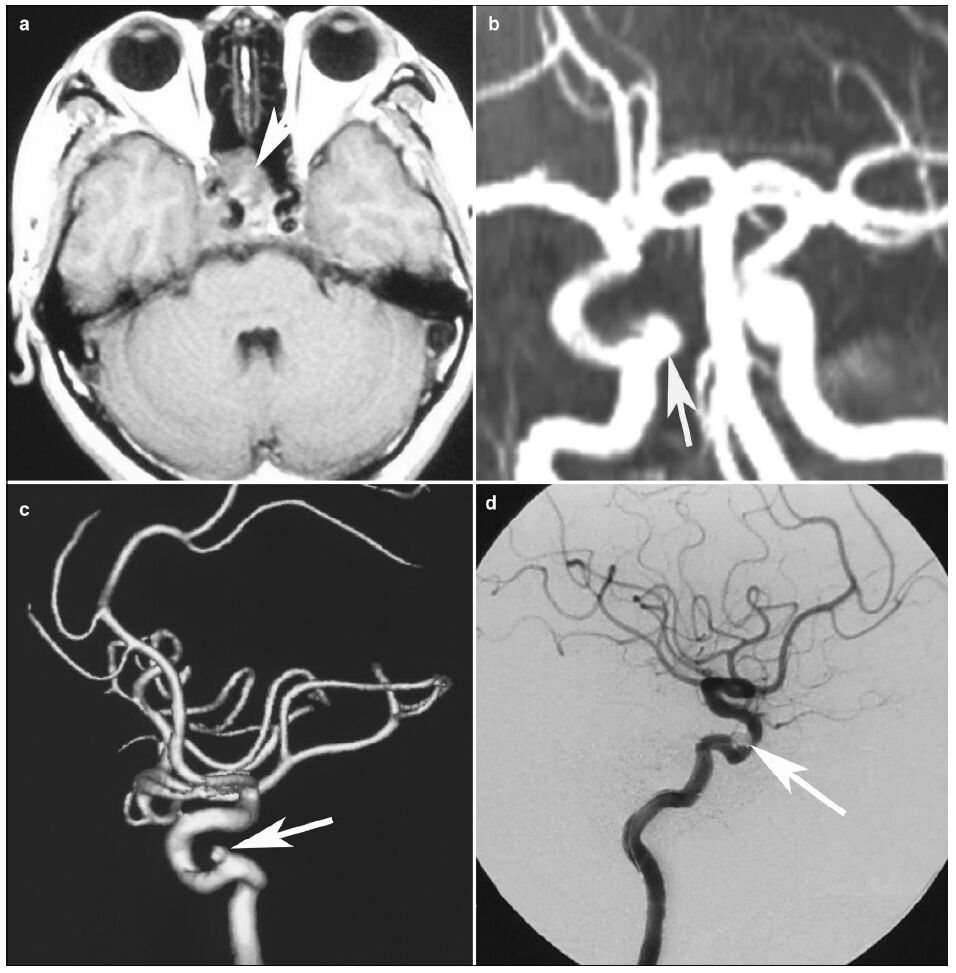
2 Case presentationPatient: male, 55 years old, suffered from sexual dysfunction for 2 years. Physical examination showed no positive signs. MRI showed a lesion located at the sellar area, and the tumor invaded the right cavernous sinus (Figure 1a). The serum prolactin was tested as 1, 600ng/ml (normal range, 1.39-24.2ng/ml). Prolac-tinoma was diagnosed. And he took bromocriptine for 3 times a day, with a dose of 2.5mg/time. One year later, cranial MR showed no evident changes in the tumor size, although the level of serum prolactin decreased to 46.3 ng/ml. He then took the gamma knife therapy to inhibit the growth of tumor. Four months after the gamma knife therapy, he got some clear liquid flowing out of the nasal cavity when bowing his head. The liquid was tested, showing Glu: 2.7mmol/L (range 2.5-4.5 mmol/L). Therefore, the patient was diagnosed with CSF rhinorrhea. After admission, he got the nasal bleeding. The blood amount was about 30ml, and the bleeding stopped thereafter. At first, the nasal bleeding was ignored. We chose endoscopic transnasal- sphenoidal approach to resect the tumor and repair the dura defect in the diaphragma sellae. The tumor apoplexy was not found during the operation. The dura defect was repaired, and the rhinorrhea stopped after the operation. However, he got another serious epistaxis 3 months after the operation. The bleeding was stopped with stuffing and compression. A suspi-cious aneurysm of right cavernous internal carotid was found in the MRA (Figure 1b), and the aneurysm was confirmed by the digital subtraction angiography DSA (Figure 1c). The endovascular coil embolization was performed to treat the aneurysm (Figure 1d). After the endovascular treatment, the patient was completely cured and discharged. During the follow-up of next two years, he recovered well and reported no new complaints.
|
| Figure 1 MRI and DSA of the patient. a: MRI shows a lesion locating at the saddle area and invading right cavernous sinus (arrow).b: The MRA 4 months after gamma knife shows a suspicious aneurysm (arrow). c: Three-dimensional DSA confirms the existence of the aneurysm (arrow). d: DSA image after the embolization shows that the treatment effect is satisfactory (arrow). |
CSF rhinorrhea and cavernous internal carotid aneu-rysm can be caused by traumas. And they have also been reported as the complications of pituitary adenoma.There have been many reports of the coexistence of the pituitary adenoma and CSF rhinorrhea[1,10-17], or pituitary adenoma and aneurysm[18-27]. The incidence of aneurysm in patients with pituitary adenoma has been reported to be 3.7% to 7.4%[28-30]. The mechanism of the coexistence of pituitary adenoma and aneurysm is still unknown. Pia et al.[27] speculated that local circulatory changes of the pituitary adenoma might have induced the aneurysm. Other factors that might cause aneurysms include the changes in collagen metabolism[25], and hormonal influences[26].
Sometimes prolactinomas are invasive. The tumor can destroy the skull base bone and the dura of sellae region, and this can induce CSF leakage. Meanwhile, any significant reduction in the tumor size can also provide a conduit for the escape of CSF, resulting in CSF rhinorrhea[1]. Rapid tumor shrinkage after the dopamine agonist therapy[12], intratumor infarction and/or hemorrhage[15], or increased intracranial pressure can also cause CSF rhinorrhea[31]. When a CSF leak happens, it needs to be repaired.
As the nasal bleeding was not serious before the operation, we didn't pay enough attention to the symptom. And not until the serious epistaxis happened, no further managements were performed. Once the aneurysm was suspected, we performed angiography examination immediately, and the endovascular treat-ment was effective. This case taught us a lesson that we should pay attention to every symptom of the patient. Nasal bleeding may be the result of rupture of internal carotid aneurysm in prolactinoma with rhinorrhea. Rupture of aneurysm may be caused by the invasion of the tumor or the operation techniques.
The CSF rhinorrhea in pituitary adenoma patients is mainly caused by the connection between suprasellar cistern and the extracranial space resulting from the invasion of the tumor or the damage of sellar diaphragm dura during the operation. The cavernous segment of internal carotid artery locates near the sellar area, and the average distance of the bilateral internal carotid artery is around 15mm, with the mini-mum distance of 9 mm[32]. The cavernous segments of internal carotid artery always locate below the plane of the sellar base, and they often have evident twisting. In the anterior part, the carotid protuberances are located primarily below the sellar base, and are only covered by the dura of the cavernous sinus and the mucosa of the sphenoid sinus in some patients. It means that extensive removal of the lateral sellar floor can be risky[33]. The growths of invasive pituitary adenomas often destroy the bones near the sellar area and the dura of cavernous sinus. Some tumors may grow along the internal carotid artery, and the carotid artery might be damaged by the tumor or the operation techniques. When the aneurysm happens at cavernous segment, it is easily to be injured.
The pituitary adenoma patients who suffer from preoperative rhinorrhea can be mainly classified into two categories: patients with invasive pituitary adenoma directly destroying skull base structures and patients with macro-prolactinomas after the treatment of bromocriptine. de Lacy et al. reported that pituitary adenoma invading sphenoid sinus often coexisted with CSF rhinorrhea[34]. Meanwhile, Raymond et al.[9] thought that the susceptible factors causing iatrogenic internal carotid injuries included large invasive pitui-tary adenomas, trying to remove the cavernous sinus invading tumor through transsphenoidal approach, radiotherapy, and chemotherapy (especially those who take bromocriptine for a long time). The patient in our study had undergone radiotherapy and surgical operation. He had also suffered from the CSF rhinorrhea and epistaxis. We believe that patients with pituitary adenoma and CSF rhinorrhea are more likely to suffer from cavernous internal carotid injury than other pituitary adenoma patients.
MRI has become a routine pre-operative examina-tion for patients with pituitary adenoma. However, MRA and DSA are still not compulsory pre-operative examination for patients with pituitary adenoma. It was reported that patients with pituitary adenoma could suffer from internal carotid aneurysm in cavernous sinus, and the aneurysm could be confirmed by DSA[35]. Previously, we didn't perform angiography examination on patients with pituitary adenoma. But after discovering the present case, we thought that MRA should be performed to know the vascular conditions of the patients with pituitary adenoma and CSF rhinorrhea or patients with internal carotid artery encased by the tumor, especially on the patients with history of nasal bleeding. Even though most patients would get negative results, we thought that this method is meaningful. If positive results are found, it may save the patients' life.
The rupture of cavernous internal carotid can often cause fatal consequence. Therefore, the possibility of the rupture of aneurysm should be taken into account, before or during the operation, especially in the pituitary adenoma patients with nasal bleeding and CSF rhinorrhea. We should perform emergent vascular examination after controlling the hemorrhage as soon as possible. When dealing with such cases, we used stuffing and compression to stop the hemorrhage. Then the endovascular treatment can be effective.
4 ConclusionsThe coexistence of CSF rhinorrhea and pituitary adeno-ma is a high risk factor for the rupture of cavernous internal carotid aneurysm. When treating patients with pituitary adenoma and CSF rhinorrhea, we should exclude the aneurysm by means of angiography examination. When nasal bleeding occurs, the possi-bility of hemorrhage of internal carotid should be considered. And appropriate measures should be taken immediately.
| [1] | Landolt AM. Cerebrospinal fluid rhinorrhea: A complication of therapy for invasive prolactinomas. Neurosurgery , 1982, 11 (3) : 395–401. DOI:10.1227/00006123-198209000-00010 |
| [2] | Teramoto A. Contemporary transsphenoidal surgery for pituitary adenomas with emphasis on complications. Biomed Pharmacother , 2002, 56 (Suppl 1) : 154s–157s. |
| [3] | Han ZL, He DS, Mao ZG, Wang HJ. Cerebrospinal fluid rhinorrhea following trans-sphenoidal pituitary macroadenoma surgery: Experience from 592 patients. Clin Neurol Neurosurg , 2008, 110 (6) : 570–579. DOI:10.1016/j.clineuro.2008.02.017 |
| [4] | Wax MK, Ramadan HH, Ortiz O, Wetmore SJ. Contemporary management of cerebrospinal fluid rhinorrhea. Otolaryngol Head Neck Surg , 1997, 116 (4) : 442–449. DOI:10.1016/S0194-5998(97)70292-4 |
| [5] | Liu P, Wu S, Li Z, Wang B. Surgical strategy for cerebrospinal fluid rhinorrhea repair. Neurosurgery , 2010, 66 (6 Suppl Operative) : 281–285. |
| [6] | Oskouian RJ, Kelly DF, Laws ER Jr. Vascular injury and transsphenoidal surgery. Front Horm Res , 2006, 34 : 256–278. DOI:10.1159/000091586 |
| [7] | Imamura J, Okuzono T, Okuzono Y. Fatal epistaxis caused by rupture of an intratumoral aneurysm enclosed by a large prolactinoma-Case report. Neurol Med Chir , 1998, 38 (10) : 654–656. DOI:10.2176/nmc.38.654 |
| [8] | Ciric I, Ragin A, Baumgartner C, Pierce D. Complications of transsphenoidal surgery: Results of a national survey, review of the literature, and personal experience. Neurosurgery , 1997, 40 (2) : 225–227. DOI:10.1097/00006123-199702000-00001 |
| [9] | Raymond J, Hardy J, Czepko R, Roy D. Arterial injuries in transsphenoidal surgery for pituitary adenoma; the role of angiography and endovascular treatment. AJNR Am J Neuroradiol , 1997, 18 (4) : 655–665. |
| [10] | Suliman SGI, Gurlek A, Byrne JV, Sullivan N, Thanabalasingham G, Cudlip S, Ansorge O, Wass JAH. Nonsurgical cerebrospinal fluid rhinorrhea in invasive macroprolactinoma: Incidence, radiological, and clinicopathological features. J Clin Endocrinol Metab , 2007, 92 (10) : 3829–3835. DOI:10.1210/jc.2007-0373 |
| [11] | Hanel RA, Prevedello DM, Correa A, Antoniuk A, Araújo JC. Cerebrospinal fluid fistula as the presenting manifestation of pituitary adenoma: Case report with a 4-year follow-up. Arq Neuropsiquiatr , 2001, 59 (2-A) : 263–265. |
| [12] | Campbell RL, Zeman W, Joyner J. Spontaneous rhinorrhea due to pituicytoma. Case report. J Neurosurg , 1996, 25 (2) : 208–210. |
| [13] | Nutkiewicz A, DeFeo DR, Kohut RI, Fierstein S. Cerebrospinal fluid rhinorrhea as a presentation of pituitary adenoma. Neurosurgery , 1980, 6 (2) : 195–197. DOI:10.1227/00006123-198002000-00015 |
| [14] | Rothrock JF, Laguna JF, Reynolds AF. CSF rhinorrhea from untreated pituitary adenoma. Arch Neurol , 1982, 39 (7) : 442–443. DOI:10.1001/archneur.1982.00510190060021 |
| [15] | Kok JG, Bartelink AKM, Schulte BPM, Smals A, Pieters G, Meyer E, Merx H. Cerebrospinril fluid rhinorrhea during treatment with bromocriptine for prolactinoma. Neurology , 1985, 35 (8) : 1193–1195. DOI:10.1212/WNL.35.8.1193 |
| [16] | Obana WG, Hodes JE, Weinstein PR, Wilson CB. Cerebrospinal fluid rhinorrhea in patients with untreated pituitary adenoma: Report of two cases. Surg Neurol , 1990, 33 (5) : 336–340. DOI:10.1016/0090-3019(90)90202-Z |
| [17] | Carroll WR, Cohen S, Sullivan MJ. Spontaneous CSF rhinorrhea: An unusual presentation of a pituitary adenoma. Otolaryngol Head Neck Surg , 1991, 104 (3) : 380–383. DOI:10.1177/019459989110400316 |
| [18] | Almeida Silva JM, Campos RR, Souza RR, Sette Dos Santos ME, Aguiar GB. Spontaneous subarachnoid haemorrhage from rupture of an anterior communicating artery aneurysm in a patient with pituitary macroadenoma. Neurocirugía , 2014, 25 (2) : 81–85. DOI:10.1016/j.neucir.2013.03.005 |
| [19] | Tsuchida T, Tanaka R, Yokoyama M, Sato H. Rupture of anterior communicating artery aneurysm during transsphenoidal surgery for pituitary adenoma. Surg Neurol , 1983, 20 (1) : 67–70. DOI:10.1016/0090-3019(83)90110-6 |
| [20] | Chen ST, Chen SD, Ryu SJ, Hsu TF, Heimburger RF. Pituitary apoplexy with intracerebral hemorrhage simulating rupture of an anterior cerebral artery aneurysm. Surg Neurol , 1988, 29 (4) : 322–325. DOI:10.1016/0090-3019(88)90166-8 |
| [21] | Laidlaw JD, Tress B, Gonzales MF, Wray AC, Ng WH, O'Brien JM. Coexistence of aneurysmal subarachnoid haemorrhage and pituitary apoplexy: Case report and review of the literature. J Clin Neurosci , 2003, 10 (4) : 478–482. DOI:10.1016/S0967-5868(02)00323-5 |
| [22] | Rustagi T, Uy EM, Rai M, Kannan S, Senatus P. Intracranial hemorrhage from undetected aneurysmal rupture complicating transphenoidal pituitary adenoma resection. Conn Med , 2011, 75 (7) : 393–398. |
| [23] | Bulsara KR, Karavadia SS, Powers CJ, Paullus WC. Association between pituitary adenomas and intracranial aneurysms: An illustrative case and review of the literature. Neurol India , 2007, 55 (4) : 410–412. DOI:10.4103/0028-3886.33307 |
| [24] | Curto L, Squadrito S, Almoto B, Longo M, Granata F, Salpietro F, Torre ML, Marini F, Trimarchi F, Cannavo S. MRI finding of simultaneous coexistence of growth hormone-secreting pituitary adenoma with intracranial meningioma and carotid artery aneurysms: Report of a case. Pituitary , 2007, 10 (3) : 299–305. DOI:10.1007/s11102-007-0011-4 |
| [25] | Acqui M, Ferrante L, Fraioli B, Cosentino F, Fortuna A, Mastronardi L. Association between intracranial aneurysms and pituitary adenomas. AEtiopathogenetic hypotheses. Neurochirurgia , 1987, 30 (6) : 177–181. |
| [26] | Acqui M, Ferrante L, Matronardi L, d'Addetta R. Alteration of the collagen type Ⅲ/type I ratio and intracranial saccular aneurysms in GH-secreting hypophyseal adenomas. Ital J Neurol Sci , 1988, 9 (4) : 365–368. DOI:10.1007/BF02334000 |
| [27] | Pia HW, Obrador S, Martin JG. Association of brain tumours and arterial intracranial aneurysms. Acta Neurochir , 1972, 27 (3) : 189–204. |
| [28] | Pant B, Arita K, Kurisu K, Tominaga A, Eguchi K, Uozumi T. Incidence of intracranial aneurysm associated with pituitary adenoma. Neurosurg Rev , 1997, 20 (1) : 13–17. DOI:10.1007/BF01390519 |
| [29] | Wakai S, Fukushima T, Furihata T, Sano K. Association of cerebral aneurysm with pituitary adenoma. Surg Neurol , 1979, 12 (6) : 503–507. |
| [30] | Nakagawara J, Suematsu K, Nakamura J, Hotta T, Kamada H, Sasaki T, Hyogo T. Pituitary apoplexy with an unruptured carotid-ophthalmic aneurysm. No Shinkei Geka , 1985, 13 (3) : 307–311. |
| [31] | Ommaya AK, Di Chiro G, Baldwin M, Pennybacker JB. Non-traumatic cerebrospinal fluid rhinorrhoea. J Neurol Neurosurg Psychiatry , 1968, 31 (3) : 214–225. DOI:10.1136/jnnp.31.3.214 |
| [32] | Renn WH, Rhoton AL Jr. Microsurgical anatomy of the sellar region. J Neurosurg , 1975, 43 (3) : 288–298. DOI:10.3171/jns.1975.43.3.0288 |
| [33] | Yilmazlar S, Kocaeli H, Eyigor O, Hakyemez B, Korfali E. Clinical importance of the basal cavernous sinuses and cavernous carotid arteries relative to the pituitary gland and macroadenomas: Quantitative analysis of the complete anatomy. Surg Neurol , 2008, 70 (2) : 165–174. DOI:10.1016/j.surneu.2007.06.094 |
| [34] | de Lacy P, Benjamin S, Dixon R, Stephens JW, Redfern R, Price DE. Is surgical intervention frequently required for medically managed macroprolactinomas? A study of spontaneous cerebrospinal fluid rhinorrhea. Surg Neurol , 2009, 72 (5) : 461–463. DOI:10.1016/j.surneu.2009.06.005 |
| [35] | Yang MY, Chen C, Shen CC. Cavernous aneurysm and pituitary adenoma: Management of dual intrasellar lesions. J Clin Neurosci , 2005, 12 (4) : 477–481. DOI:10.1016/j.jocn.2004.05.020 |