


A logarithmic spiral, equiangular spiral, or growth spiral is a self-similar spiral curve, which often appears in nature, e.g., mollusk shells. The logarithmic spiral in nature is a simple, economical, and high-performance construction model. For example, a logarithmic spiral can be seen in sunflowers due to a self-organized growth process whereby new seeds are generated in the center at a fixed frequency and then repel each other by steric repulsion. Consequently, the maximization of the distance between seeds leads to a subtype of logarithmic spiral pattern named the golden or Fibonacci spiral[1]. In the normal tissues of the human body, the cochlea also has the form of a logarithmic spiral[2]. However, approximate logarithmic spirals are rarely, if ever, reported in tumors. It is unclear whether this is because tumors always grow in a disorganized fashion with a different growth pattern from that seen in healthy tissues or simply because a logarithmic spiral was yet to be found in human tumors. These issues have never been answered with irrefutable evidence. Recently, we treated a patient with a dermoid cyst, where magnetic resonance imaging (MRI) showed a typical logarithmic spiral. Furthermore, the logarithmic spiral could be described mathematically with a high goodness of fit. In this paper, we present this case with various clinical images. Written informed consent was obtained from the patient.
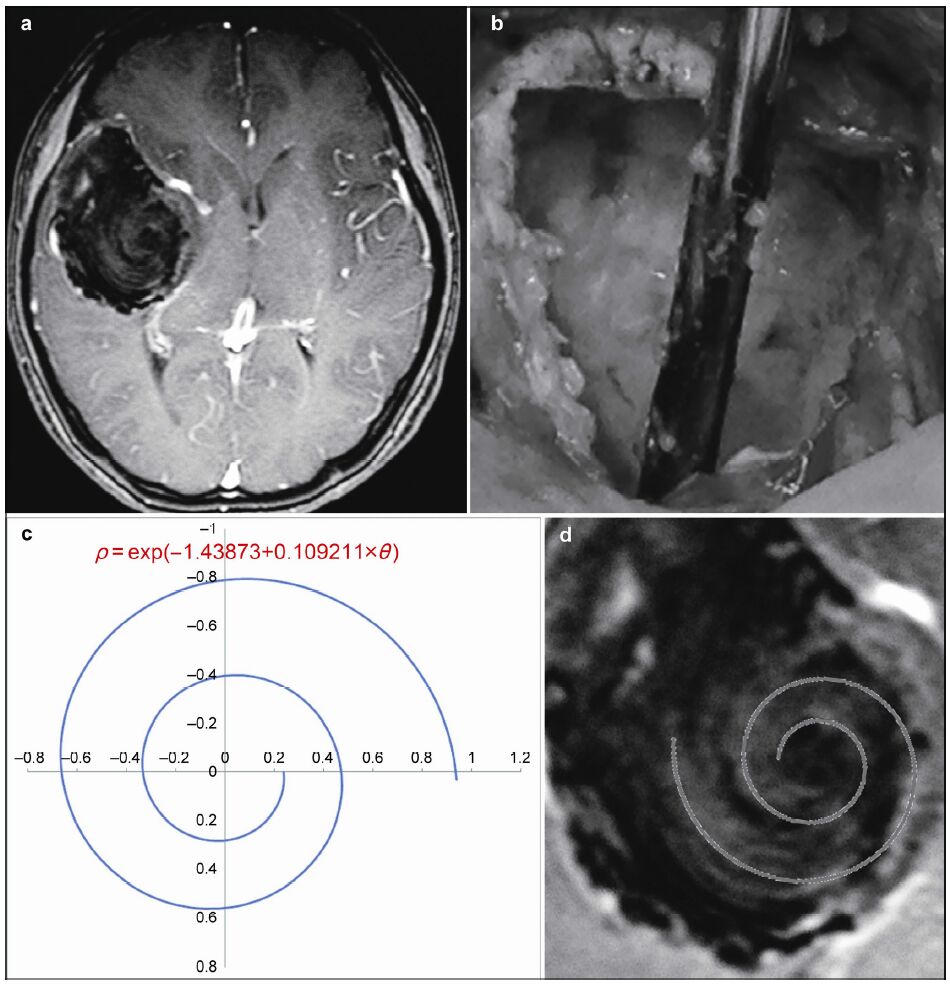
2 Case presentationA 26-year-old woman with a one-year history of headache was admitted to our department. There were no obvious positive neurological signs on physical examination. Computed tomography showed a prominent well-circumscribed hypodense area with isodense contents in the left temporal lobe (data not shown); MRI revealed a 4-cm mass with isointense or hypointense mixed signals on T1-weighted imaging and scanty enhancement after gadolinium injection (Figure 1a). Perioperatively, we found an intact tumor capsule with contents that appeared similar to egg-drop soup mixed with hairs (Figure 1b). These features suggested a diagnosis of a dermoid cyst, which was confirmed by postoperative pathological examination. Based on the typical logarithmic spiral pattern of the dermoid cyst image, we derived an equation to describe the pattern with a high goodness of fit (Figures 1c and Figures 1d).
|
| Figure 1 a. Image of the intracranial dermoid cyst. Magnetic resonance imaging revealed a 4-cm lesion with isointense or hypointense mixed signals on T1-weighted images and scanty enhancement after gadolinium injection. b. Tumor contents with an appearance like egg-drop soup. c. Graphical representation of the equation describing the spiral pattern in the cyst. d. Merged image of the calculated spiral curve and spiral seen in the tumor demonstrating a good fit. |
Logarithmic spiral-like structures have been found in the normal tissues of human beings[2], but have never been found in a tumor. However, according to Oldershaw's statement of cosmic self-similarity[3], all structures in the cosmos share a common design principle, e.g., self-similar symmetry even occurs between atomic nuclei. Therefore, there must be some trace of a logarithmic spiral pattern in tumors that has not been found until now.
The logarithmic spiral occurs in biological growth. It is well known that cells generally remain in the so-called logarithmic phase in suitable environmental conditions in vitro. However, in vivo, the complex nature of interfering factors means that typical spiral structures are rarely seen. Dermoid cysts, a type of congenital benign lesion, arise from the inclusion of embryonic ectoderm into the neural tube during the 5th to 6th weeks of fetal life[4,5]. It grows slowly under the protection of the skull, which provides the tumor with a relatively stable environment. In addition, the anatomical structure of the temporal lobe is simple, with no obvious physiological function, which allows a long course of disease and large lesion growth (Figure 1a). Moreover, the fatty liquids among the tumor tissues provide an even more conducive environment for tumor growth (Figure 1b). The inclu-sion of embryonic ectoderm in the neural tube is like a cluster of seeds in the fetal brain. These seeds, together with other parts of the brain, gradually grow following their own rules (i.e., slow three-dimensional logarithmic growth), with no neurological function.
Nature created spiral forms in the living world to pack a large number of structures in a limited space and to improve their function. For example, all human deoxyribonucleic acid molecules per cell, with a total length of 2 m, can only be packed into a nucleus with a diameter of only 5 × 10⁻⁶-20 × 10−6 m in a spiral fashion to carry as much genetic information as possible. The spiral of a sunflower also allows it to generate seeds efficiently. Therefore, from our case, we may also con-clude that tumors, at least sometimes, also develop following the pattern of a logarithmic spiral. However, the general interactions between spiral units make a simple or typical spiral almost invisible, which in turn makes the tissue's construction a highly disorganized mass.
Acknowledgements
We thank Dr. Jiakou Wang for helping us calculate the equation to describe the logarithmic spiral.
Conflict of interests
All authors certify that they have no affiliations with or involvement in any organization or entity with any financial interest, or non-financial interest in the subject matter or materials discussed in this manuscript.
| [1] | Douady S, Couder Y. Phyllotaxis as a physical self-organized growth process. Phys Rev Lett , 1992, 68 (13) : 2098–2101. DOI:10.1103/PhysRevLett.68.2098 |
| [2] | Marinković S, Stanković P, Štrbac M, Tomić I, Ćetković M. Cochlea and other spiral forms in nature and art. Am J Otolaryngol , 2012, 33 (1) : 80–87. DOI:10.1016/j.amjoto.2011.01.006 |
| [3] | Oldershaw RL. Self-similar cosmological model: Introduction and empirical tests. Int J Theor Phys , 1989, 28 (6) : 669–694. DOI:10.1007/BF00669984 |
| [4] | Kim KS, Weinberg PE. Dermoid tumor. Surg Neurol , 1981, 15 (5) : 375–376. DOI:10.1016/0090-3019(81)90175-0 |
| [5] | Osborn AG. Diagnostic Neuroradiology. St. Louis: Mosby, 1994. |