| Original Articles |
|


|
|
|
| Effects of aging on working memory performance and prefrontal cortex activity: A time-resolved spectroscopy study |
| Jie Shi1, Wenjing Zhou1, Tongchao Geng2, Huancong Zuo1, Masahiro Tanida3, Kaoru Sakatani4 |
1 Department of Neurosurgery, Tsinghua University Yuquan Hospital, Beijing 100040, China;
2 Department of Neurology, Tsinghua University Yuquan Hospital, Beijing 100040, China;
3 Shiseido Research Center, Shin-Yokohama 224-8558, Japan;
4 NEWCAT Research Institute, Nihon University College of Engineering, Fukushima 963-8642, Japan |
|
|
|
|
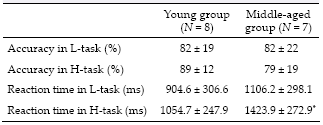
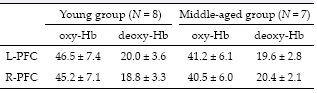
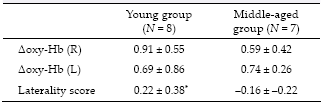
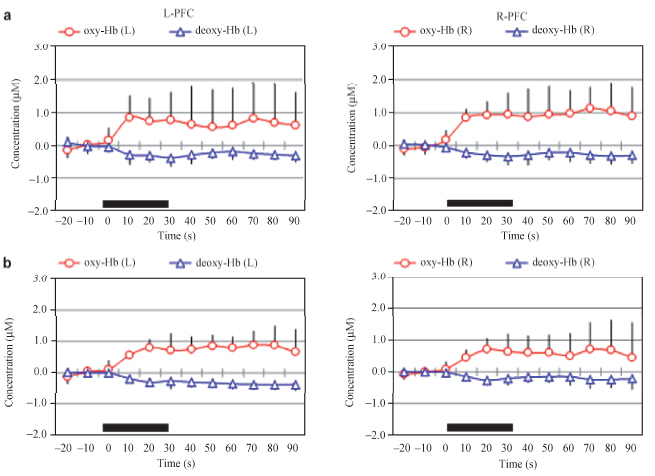
Abstract Objective: This study aimed to employ time-resolved spectroscopy (TRS) to explore age-related differences in prefrontal cortex (PFC) activity while subjects performed a working memory task. Methods: We employed TRS to measure PFC activity in ten healthy younger and ten healthy older subjects while they performed a working memory (WM) task. All subjects performed the Sternberg test (ST) in which the memory-set size varied between one and six digits. Using TRS, we recorded changes in cerebral blood oxygenation as a measure of changes in PFC activity during the task. In order to identify left/right asymmetry of PFC activity during the working memory task, we calculated the laterality score, i.e., Δoxy-Hb (right Δoxy-Hb—left Δoxy-Hb); positive values indicate greater activity in the right PFC, while negative values indicate greater activity in the left PFC. Results: During the ST, statistical analyses showed no significant differences between the younger and older groups in accuracy for low memory-load and high memoryload. In high memory-load tasks, however, older subjects were slower than younger subjects (P < 0.05). We found that the younger group showed right lateral responses with a stronger right than left activation in the frontal pole, whereas the older group showed bilateral responses (P < 0.05). Conclusions: The present results are consistent with the hemispheric asymmetry reduction in older adults (HAROLD) model; working memory tasks cause asymmetrical PFC activation in younger adults, while older adults tend to show reduced hemispheric lateralization.
|
|
Received: 06 January 2016
Published: 31 March 2016
|
|
Corresponding Authors:
Kaoru Sakatani, E-mail: sakatani.kaoru@nihon-u.ac.jp
E-mail: sakatani.kaoru@nihon-u.ac.jp
|
|
|
[1] Cabeza R. Hemispheric asymmetry reduction in older adults: The HAROLD model. Psychol Aging 2002, 17(1): 85-100.
[2] Sakatani K, Tanida M, Hirao N, Takemura N. Ginkobiloba extract improves working memory performance in middleaged women: Role of asymmetry of prefrontal cortex activity during a working memory task. Adv Exp Med Biol 2014, 812: 295-301.
[3] Dixit NK, Gerton BK, Kohn P, Meyer-Lindenberg A, Berman KF. Age-related changes in rCBF activation during an N-back working memory paradigm occur prior to age 50. NeuroImage 2000, 11(5 Suppl): S94.
[4] Oda M, Yamashita Y, Nakano T, Suzuki A, Shimizu K, Hirano I, Shimomura F, Ohmae E, Suzuki T, Tsuchiya Y. Near-infrared time-resolved spectroscopy system for tissue oxygenation monitor. SPIE 2000, 4160: 204-210.
[5] Tanida M, Katsuyama M, Sakatani K. Relation between mental stress-induced prefrontal cortex activity and skin conditions: A near-infrared spectroscopy study. Brain Res 2007, 1184: 210-216.
[6] Berlingeri M, Danelli L, Bottini G, Sberna M, Paulesu E. Reassessing the HAROLD model: Is the hemispheric asymmetry reduction in older adults: A special case of compensatory-related utilisation of neural circuits? Exp Brain Res 2013, 224(3): 393-410.
[7] Aron AR, Robbins TW, Poldrack RA. Inhibition and the right inferior frontal cortex. Trends Cogn Sci 2004, 8(4): 170-177.
[8] Kirilina E, Jelzow A, Heine A, Niessing M, Wabnitz H, Brühl R, Ittermann B, Jacobs AM, Tachtsidis I. The physiological origin of task-evoked systemic artefacts in functional near infrared spectroscopy. NeuroImage 2012, 61(1): 70-81.
[9] Kastrup A, Dichgans J, Niemeier M, Schabet M. Changes of cerebrovascular CO2 reactivity during normal aging. Stroke 1998, 29(7): 1311-1314. |
|
Viewed |
|
|
|
Full text
|
|
|
|
|
Abstract
|
|
|
|
|
Cited |
|
|
|
|
| |
Shared |
|
|
|
|
| |
Discussed |
|
|
|
|