| Original Articles |
|


|
|
|
| Long-term results of a simultaneous trial of deep brain and motor cortex stimulation in refractory neuropathic pain |
| Byung-chul Son1,2, Jin-gyu Choi1, Sang-woo Ha3, Deog-ryeong Kim4 |
1 Department of Neurosurgery, Seoul St. Mary's Hospital, College of Medicine, the Catholic University of Korea, Seoul 06591, Republic of Korea;
2 Catholic Neuroscience Institute, College of Medicine, the Catholic University of Korea, Seoul 06591, Republic of Korea;
3 Department of Neurosurgery, Chosun University Hospital, College of Gwangju 61452, Republic of Korea;
4 Department of Neurosurgery, Nowon Eulji Hospital, College of Medicine, Eulji University, Seongnam 826802, Republic of Korea |
|
|
|
|
Abstract Objective: Although deep brain stimulation (DBS) and motor cortex stimulation (MCS) are effective in patients with refractory neuropathic pain, their application is still empirical; there is no consensus on which technique is better.
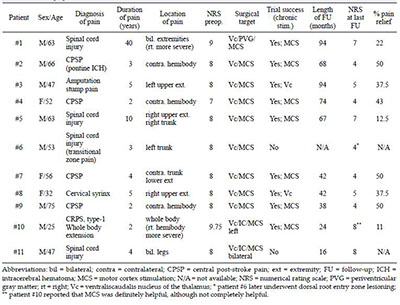
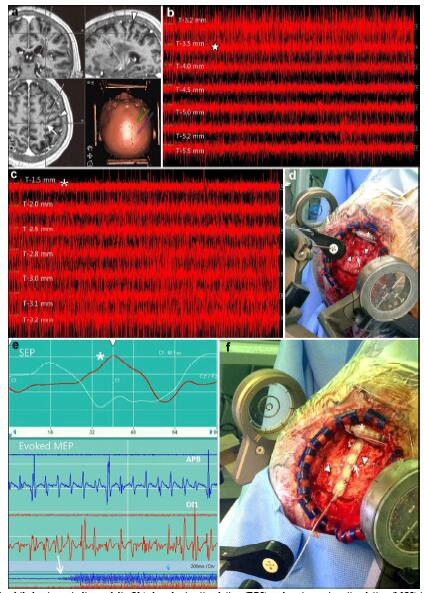
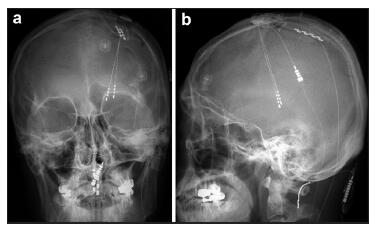
Methods: To enhance the success rate of trial stimulation of invasive neuromodulation techniques and identify approapriate stimulation targets in individual patients, we performed a simultaneous trial of thalamic ventralis caudalis (Vc) DBS and MCS in 11 patients with chronic neuropathic pain and assessed the results of the trial stimulation and long-term analgesia.
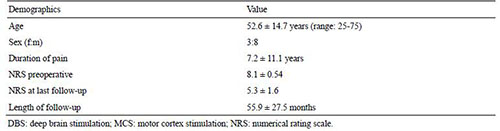
Results: Of the 11 patients implanted with both DBS and MCS electrodes, nine (81.8%) had successful trials. Seven of these nine patients (77.8%) responded to MCS, and two (18.2%) responded to Vc DBS. With long-term follow-up (56 ± 27.5 months), the mean numerical rating scale decreased significantly (P < 0.05). The degree of percentage pain relief in the chronic MCS (n = 7) and chronic DBS (n = 2) groups were 34.1% ± 18.2% and 37.5%, respectively, and there was no significant difference (P = 0.807). Five out of the seven MCS patients (71%) and both DBS patients had long-term success with the treatments, defined as >30% pain relief compared with baseline.
Conclusions: With simultaneous trial of DBS and MCS, we could enhance the success rate of invasive trials. Considering the initial success rate and the less invasive nature of epidural MCS over DBS, we suggest that MCS may be a better, initial means of treatment in chronic intractable neuropathic pain. Further investigations including other subcortical target-associated medial pain pathways are warranted.
|
|
Received: 02 January 2017
Published: 31 March 2017
|
|
Viewed |
|
|
|
Full text
|
|
|
|
|
Abstract
|
|
|
|
|
Cited |
|
|
|
|
| |
Shared |
|
|
|
|
| |
Discussed |
|
|
|
|