A study of the effects of 3,5-diiodo-L-thyronine in the tail suspension and forced swim models of depression
Nataliia Markova1,2,3, Anton Chernopiatko4, Aslan Kubatiev2, Sergey Bachurin1, Harry M. W. Steinbusch3, Tatyana Strekalova3
1 Laboratory of Biomolecular screening, Institute of Physiologically Active Compounds, Russian Academy of Sciences, Severnii Proezd 1, Chernogolovka, Moscow Region 142432, Russia;
2 Laboratory of Cognitive dysfunctions, Federal State Budgetary Scientific Institution"Institute of General Pathology and Pathophysiology", Baltiyskaia Str. 8, Moscow 125315, Russia;
3 Department of Neuroscience, School for Mental Health and Neuroscience, Maastricht University, Universiteitssingel 40, Maastricht NL 6229 ER, the Netherlands;
4 Section of Neuropharmacology Research, Timantti AB, Sundbyberg 104, Stockholm 17407, Sweden
A study of the effects of 3,5-diiodo-L-thyronine in the tail suspension and forced swim models of depression
Nataliia Markova1,2,3, Anton Chernopiatko4, Aslan Kubatiev2, Sergey Bachurin1, Harry M. W. Steinbusch3, Tatyana Strekalova3
1 Laboratory of Biomolecular screening, Institute of Physiologically Active Compounds, Russian Academy of Sciences, Severnii Proezd 1, Chernogolovka, Moscow Region 142432, Russia;
2 Laboratory of Cognitive dysfunctions, Federal State Budgetary Scientific Institution"Institute of General Pathology and Pathophysiology", Baltiyskaia Str. 8, Moscow 125315, Russia;
3 Department of Neuroscience, School for Mental Health and Neuroscience, Maastricht University, Universiteitssingel 40, Maastricht NL 6229 ER, the Netherlands;
4 Section of Neuropharmacology Research, Timantti AB, Sundbyberg 104, Stockholm 17407, Sweden
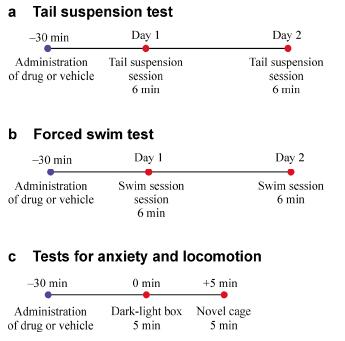
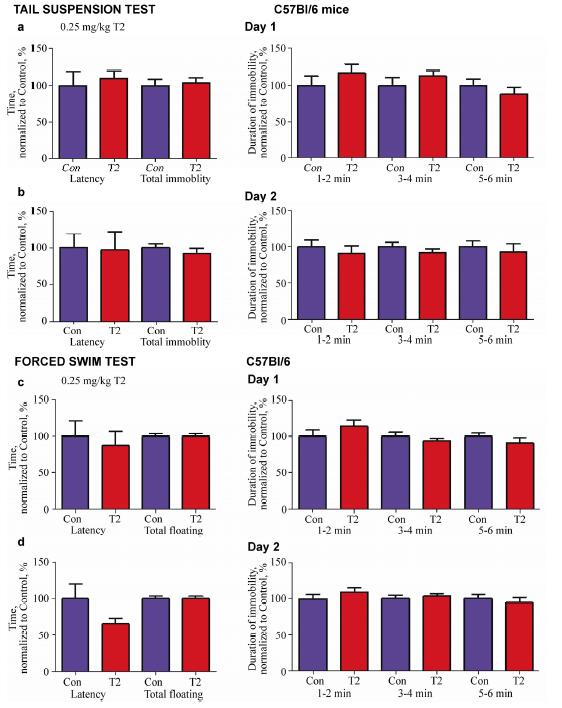
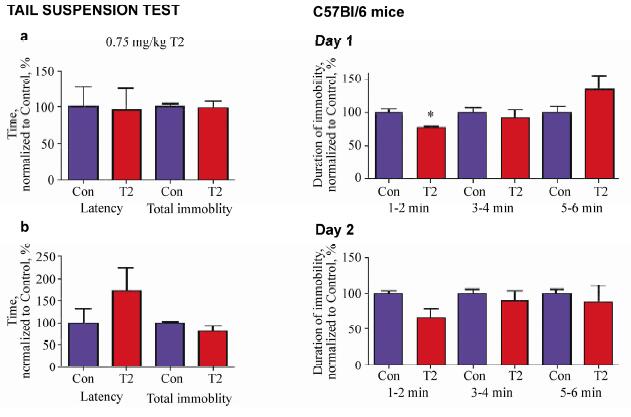
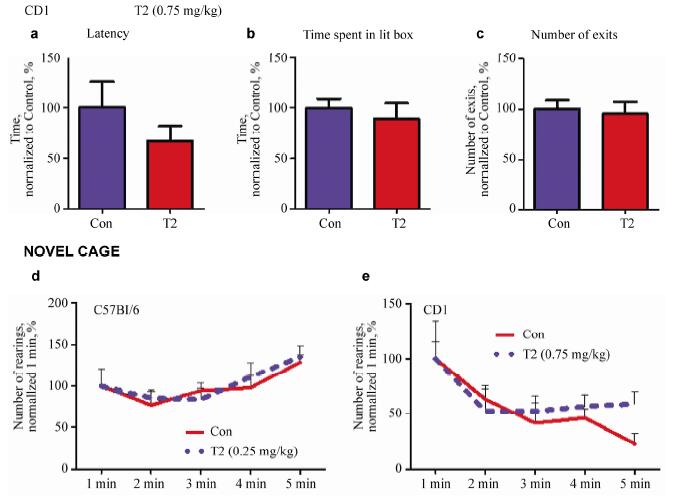
摘要 Objectives: Recent findings have further highlighted the role of the thyroid system in the pathophysiology of depression and revealed new physiologically relevant elements of the thyroid system. Our previous study showed an antidepressant-like effect of 3,5-diiodo-L-thyronine (T2), which was previously considered to be a physiologically inactive molecule, in mice. Here, we aimed to investigate the antidepressant-like effects of T2 further. Methods: We studied the effects of bolus injections of T2 to C57Bl6J mice at doses of 0.25 or 0.75 mg/kg with the tail suspension and forced swim models. The effects of the higher dose were investigated in CD1 mice in the forced swim test. Potential behavioral effects of these treatments were also studied using the novel cage and dark-light box tests. Results: A reduction of depressive-like behavior was found in mice treated with 0.75 mg/kg of T2 in the tail suspension test, but not in the forced swim test. Locomotion and anxiety variables were unaltered following treatment with T2. There were no significant changes after bolus administration of 0.25 mg/kg T2 in either test for depressive-like behavior. Thus, bolus injection of T2 at the dose 0.75 mg/kg can induce antidepressant-like effects without affecting other behaviors. Conclusions: A discrepant result in the forced swim test may be due to its different sensitivity to T2 compared with the tail suspension paradigm. Furthermore, the development of procedural modifications of this model can be useful in its application in pre-clinical studies.
Abstract: Objectives: Recent findings have further highlighted the role of the thyroid system in the pathophysiology of depression and revealed new physiologically relevant elements of the thyroid system. Our previous study showed an antidepressant-like effect of 3,5-diiodo-L-thyronine (T2), which was previously considered to be a physiologically inactive molecule, in mice. Here, we aimed to investigate the antidepressant-like effects of T2 further. Methods: We studied the effects of bolus injections of T2 to C57Bl6J mice at doses of 0.25 or 0.75 mg/kg with the tail suspension and forced swim models. The effects of the higher dose were investigated in CD1 mice in the forced swim test. Potential behavioral effects of these treatments were also studied using the novel cage and dark-light box tests. Results: A reduction of depressive-like behavior was found in mice treated with 0.75 mg/kg of T2 in the tail suspension test, but not in the forced swim test. Locomotion and anxiety variables were unaltered following treatment with T2. There were no significant changes after bolus administration of 0.25 mg/kg T2 in either test for depressive-like behavior. Thus, bolus injection of T2 at the dose 0.75 mg/kg can induce antidepressant-like effects without affecting other behaviors. Conclusions: A discrepant result in the forced swim test may be due to its different sensitivity to T2 compared with the tail suspension paradigm. Furthermore, the development of procedural modifications of this model can be useful in its application in pre-clinical studies.
Nataliia Markova, Anton Chernopiatko, Aslan Kubatiev, Sergey Bachurin, Harry M. W. Steinbusch, Tatyana Strekalova. A study of the effects of 3,5-diiodo-L-thyronine in the tail suspension and forced swim models of depression[J]. 临床转化神经科学, 2016, 2(2): 96-107.
Nataliia Markova, Anton Chernopiatko, Aslan Kubatiev, Sergey Bachurin, Harry M. W. Steinbusch, Tatyana Strekalova. A study of the effects of 3,5-diiodo-L-thyronine in the tail suspension and forced swim models of depression. Translational Neuroscience and Clinics, 2016, 2(2): 96-107.
[1] Porterfield SP, Hendrich CE. The role of thyroid hormones in prenatal and neonatal neurological development-current perspectives. Endocr Rev 1993, 14(1):94-106.
[2] Bernal J, Nunez J. Thyroid hormones and brain development. Eur J Endocrinol 1995, 133(4):390-398.
[3] Baumgartner A. Thyroxine and the treatment of affective disorders:An overview of the results of basic and clinical research. Int J Neuropsychopharmacol 2000, 3(2):149-165.
[4] Moreau X, Jeanningros R, Mazzola-Pomietto P. Chronic effects of triiodothyronine in combination with imipramine on 5-HT transporter, 5-HT1A and 5-HT2A receptors in adult rat brain. Neuropsychopharmacology 2001, 24(6):652-662.
[5] Bauer M, Heinz A, Whybrow PC. Thyroid hormones, serotonin and mood:Of synergy and significance in the adult brain. Mol Psychiatry 2002, 7(2):140-156.
[6] Abraham G, Milev R, Stuart Lawson J. T3 augmentation of SSRI resistant depression. J Affect Disord 2006, 91(2-3):211-215.
[7] Goglia F. Biological effects of 3, 5-diiodothyronine (T2). Biochemistry (Mosc) 2005, 70(2):164-172.
[8] Schroeder AC, Privalsky ML. Thyroid hormones, T3 and T4, in the brain. Front Endocrinol (Lausanne) 2014, 5(40). DOI:10. 3389/fendo. 2014. 00040.
[9] Lombardi A, Lanni A, Moreno M, Brand MD, Goglia F. Effect of 3, 5-di-iodo-L-thyronine on the mitochondrial energy-transduction apparatus. Biochem J 1998, 330(1):521-526.
[10] Moreno M, Lombardi A, Beneduce L, Silvestri E, Pinna G, Goglia F, Lanni A. Are the effects of T3 on resting metabolic rate in euthyroid rats entirely caused by T3 itself? Endocrinology 2002, 143(2):504-510.
[11] Lanni A, Moreno M, Cioffi M, Goglia F. Effect of 3, 3'-di-iodothyronine and 3, 5-di-iodothyronine on rat liver mitochondria. J Endocrinol 1993, 136(1):59-64.
[12] De Lange P, Cioffi F, Senese R, Moreno M, Lombardi A, Silvestri E, De Matteis R, Lionetti L, Mollica MP, Goglia F, et al. Nonthyrotoxic prevention of diet-induced insulin resistance by 3, 5-diiodo-L-thyronine in rats. Diabetes 2011, 60(11):2730-2739.
[13] Del Viscovo A, Secondo A, Esposito A, Goglia F, Moreno M, Canzoniero LMT. Intracellular and plasma membrane-initiated pathways involved in the[Ca2+]i elevations induced by iodothyronines (T3 and T2) in pituitary GH3 cells. Am J Physiol Endocrinol Metab 2012, 302(11):1419-1430.
[14] Ball SG, Sokolov J, Chin WW. 3, 5-Diiodo-L-thyronine (T2) has selective thyromimetic effects in vivo and in vitro. J Mol Endocrinol 1997, 19(2):137-147.
[15] Zarate CA Jr, Singh JB, Carlson PJ, Brutsche NE, Ameli R, Luckenbaugh DA, Charney DS, Manji HK. A randomized trial of an N-methyl-D-aspartate antagonist in treatment-resistant major depression. Arch Gen Psychiatry 2006, 63(8):856-864.
[16] Pinna G, Broedel O, Eravci M, Stoltenburg-Didinger G, Plueckhan H, Fuxius S, Meinhold H, Baumgartner A. Thyroid hormones in the rat amygdala as common targets for antidepressant drugs, mood stabilizers, and sleep deprivation. Biol Psychiatry 2003, 54(10):1049-1059.
[17] Markova N, Chernopiatko A, Schroeter CA, Malin D, Kubatiev A, Bachurin S, Costa-Nunes J, Steinbusch HM, Strekalova T. Hippocampal gene expression of deiodinases 2 and 3 and effects of 3, 5-diiodo-L-thyronine T2 in mouse depression paradigms. Biomed Res Int 2013, DOI:10. 1155/2013/565218.
[18] Porsolt RD, Bertin A, Jalfre M. Behavioral despair in mice:A primary screening test for antidepressants. Arch Int Pharmacodyn Ther 1977, 229(2):327-336.
[19] Lucki I. The forced swimming test as a model for core and component behavioral effects of antidepressant drugs. Behav Pharmacol 1997, 8(6-7):523-532.
[20] Cryan JF, Markou A, Lucki I. Assessing antidepressant activity in rodents:Recent developments and future needs. Trends Pharmacol Sci 2002, 23(5):238-245.
[21] Steru L, Chermat R, Thierry B, Simon P. The tail suspension test:A new method for screening antidepressants in mice. Psychopharmacology 1985, 85(3):367-370.
[22] Weingartner H, Silberman E. Models of cognitive impairment:Cognitive changes in depression. Psychopharmacol Bull 1982, 18(2):27-42.
[23] Cryan JF, Mombereau C, Vassout A. The tail suspension test as a model for assessing antidepressant activity:Review of pharmacological and genetic studies in mice. Neurosci. Biobehav Rev 2005, 29(4-5):571-625.
[24] Costa-Nunes JP, Cline BH, Araújo-Correia M, Valença A, Markova N, Dolgov O, Kubatiev A, Yeritsyan N, Steinbusch HWM, Strekalova T. Animal models of depression and drug delivery with food as an effective dosing method:Evidences from studies with Celecoxib and Dicholine succinate. BioMed Res Int 2015, 2015:Article ID 596126.
[25] Jones MD, Lucki I. Sex differences in the regulation of serotonergic transmission and behavior in 5-HT receptor knockout mice. Neuropsychopharmacology 2005, 30(6):1039-1047.
[26] Ampuero E, Luarte A, Santibañez M, Varas-Godoy M, Toledo J, Diaz-Veliz G, Cavada G, Rubio FJ, Wyneken U. Two chronic stress models based on movement restriction in rats respond selectively to antidepressant drugs:Aldolase C as a potential biomarker. Int J Neuropsychopharmacol 2015, 18(10):pyv038.
[27] Yoshikawa T, Watanabe A, Ishitsuka Y, Nakaya A, Nakatani N. Identification of multiple genetic loci linked to the propensity for "behavioral despair" in mice. Genome Res 2002, 12(3):357-366.
[28] Guardiola-Lemaître B, Lenègre A, Porsolt RD. Combined effects of diazepam and melatonin in two tests for anxiolytic activity in the mouse. Pharmacol Biochem Behav 1992, 41(2):405-408.
[29] Liu XQ, Gershenfeld HK. Genetic differences in the tail-suspension test and its relationship to imipramine response among 11 inbred strains of mice. Biol Psychiatry 2001, 49(7):575-581.
[30] Malatynska E, Steinbusch HWM, Redkozubova O, Bolkunov A, Kubatiev A, Yeritsyan NB, Vignisse J, Bachurin S, Strekalova T. Anhedonic-like traits and lack of affective deficits in 18-month-old C57BL/6 mice:Implications for modeling elderly depression. Exp Gerontol 2012, 47(8):552-564.
[31] Strekalova T, Evans M, Costa-Nunes J, Bachurin S, Yeritsyan N, Couch Y, Steinbusch HMW, Eleonore Köhler S, Lesch KP, Anthony DC. Tlr4 upregulation in the brain accompanies depression-and anxiety-like behaviors induced by a high-cholesterol diet. Brain Behav Immun 2015, 48:42-47.
[32] Porsolt RD, Deniel M, Jalfre M. Forced swimming in rats:Hypothermia, immobility and the effects of imipramine. Eur J Pharmacol 1979, 57(4):431-436.
[33] Bogdanova OV, Kanekar S, D'Anci KE, Renshaw PF. Factors influencing behavior in the forced swim test. Physiol Behav 2013, 118:227-239.
[34] Naudon L, Jay TM. Opposite behaviours in the forced swimming test are linked to differences in spatial working memory performances in the rat. Neuroscience 2005, 130(2):285-293.
[35] Blanchard RJ, Griebel G, Henrie JA, Blanchard DC. Differentiation of anxiolytic and panicolytic drugs by effects on rat and mouse defense test batteries. Neurosci Biobehav Rev 1997, 21(6):783-789.
[36] Perrault GH, Morel E, Zivkovic B, Sanger DJ. Activity of litoxetine and other serotonin uptake inhibitors in the tail suspension test in mice. Pharmacol Biochem Behav 1992, 42(1):45-47.
 2016, Vol. 2