摘要 Objective: To study the influence of different microsurgical methods on surgical outcomes and complications, and to improve the surgical outcomes for trigeminal neuralgia. Methods: The clinical data of 109 patients with trigeminal neuralgia, who were treated with microsurgery, were analyzed retrospectively. All patients were divided into 3 groups according to surgical modality: the trigeminal neuralgia decompression group (TND group, 19 patients), the TND and rhizotomy group (rhizotomy group, 55 patients), and the TND and selective lesioning group (lesioning group, 35 patients). The mid-term and short-term effects of microsurgery, and the occurrences of complications, were compared between the 3 groups. Results: There were no statistical differences in the frequency of complications between the 3 groups (P>0.05). Eighty-four patients were followed up for 6 to 33 months. The rate of pain disappearance was found to be 94.4% in the TND group, and 100% in both the rhizotomy and lesioning groups; thus, no significant differences were found between these 3 groups (P>0.05). Additionally, 50% of the patients in the rhizotomy group and 3.6% of the patients in the lesioning group had facial numbness while no patients were affected with facial numbness in the TND group, and the differences between these 3 groups were significant (P<0.05). Conclusions: Microsurgery is effective and safe for trigeminal neuralgia. The use of TND, in combination with selective lesioning, ensures therapeutic efficacy and improves the quality of life in postoperative patients.
Abstract: Objective: To study the influence of different microsurgical methods on surgical outcomes and complications, and to improve the surgical outcomes for trigeminal neuralgia. Methods: The clinical data of 109 patients with trigeminal neuralgia, who were treated with microsurgery, were analyzed retrospectively. All patients were divided into 3 groups according to surgical modality: the trigeminal neuralgia decompression group (TND group, 19 patients), the TND and rhizotomy group (rhizotomy group, 55 patients), and the TND and selective lesioning group (lesioning group, 35 patients). The mid-term and short-term effects of microsurgery, and the occurrences of complications, were compared between the 3 groups. Results: There were no statistical differences in the frequency of complications between the 3 groups (P>0.05). Eighty-four patients were followed up for 6 to 33 months. The rate of pain disappearance was found to be 94.4% in the TND group, and 100% in both the rhizotomy and lesioning groups; thus, no significant differences were found between these 3 groups (P>0.05). Additionally, 50% of the patients in the rhizotomy group and 3.6% of the patients in the lesioning group had facial numbness while no patients were affected with facial numbness in the TND group, and the differences between these 3 groups were significant (P<0.05). Conclusions: Microsurgery is effective and safe for trigeminal neuralgia. The use of TND, in combination with selective lesioning, ensures therapeutic efficacy and improves the quality of life in postoperative patients.
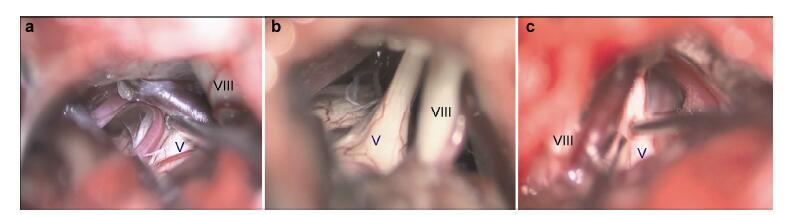
20161117200724 Figure 1 Three group for trigeminal neuragia. (a) The trigeminal nerve was compressed by the artery. (b) The trigeminal nerve without compression needed rhizotomy. (c) The selective lesion was performed on the trigeminal nerve, after decompression. V: the trigeminal nerve; VIII: the auditory nerve.
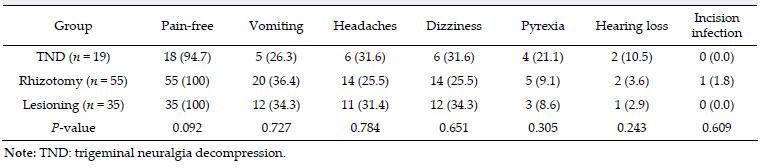
20161117200751 Short-term Outcomes and Complications in 109 Patients (n, %)
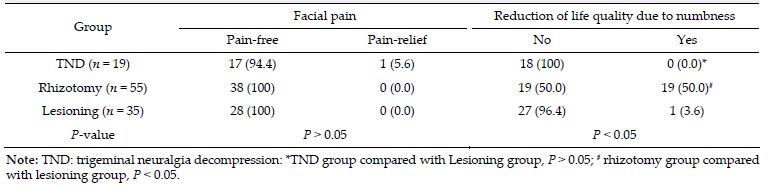
20161117200817 Mid-term Outcomes and Numbness (n, %)
[1] Siqueira SR, Teixeira MJ, Siqueira JT. Clinical charac-teristics of patients with trigeminal neuralgia referred to neurosurgery. Eur J Dent 2009, 3(3):207-212.
[2] Ong KS, Keng SB. Evaluation of surgical procedures for trigeminal neuralgia. Anesth Prog 2003, 50(4):181-188.
[3] Barker FG, Jannetta PJ, Bissonette DJ, Larkins MV, Jho HD. The long-term outcome of microvascular decompression for trigeminal neuralgia. N Engl J Med 1996, 334(17):1077-1083.
[4] Bond AE, Zada G, Gonzalez AA, Hansen C, Giannotta SL. Operative strategies for minimizing hearing loss and other major complications associated with microvascular decom-pression for trigeminal neuralgia. World Neurosurg 2010, 74(1):172-177.
[5] Sarsam Z, Garcia-Fiñana M, Nurmikko TJ, Varma TRK, Eldridge P. The long-term outcome of microvascular decompression for trigeminal neuralgia. Br J Neurosurg 2010, 24(1):18-25.
[6] Chakravarthi PS, Ghanta R, Kattimani V. Microvascular decompression treatment for trigeminal neuralgia. J Craniofac Surg 2011, 22(3):894-898.
[7] Tanrikulu L, Hastreiter P, Bassemir T, Bischoff B, Buchfelder M, Dörfler A, Naraghi R. New clinical and morphologic aspects in trigeminal neuralgia. World Neurosurg 2016, 92:189-196.
[8] Bederson JB, Wilson CB. Evaluation of microvascular decompression and partial sensory rhizotomy in 252 cases of trigeminal neuralgia. J Neurosurg 1989, 71(3):359-367.
[9] Revuelta-Gutierrez R, Martinez-Anda JJ, Coll JB, Campos-Romo A, Perez-Peña N. Efficacy and safety of root compression of trigeminal nerve for trigeminal neuralgia without evidence of vascular compression. World Neurosurg 2013, 80(3-4):385-389.
[10] Cheng J, Lei D, Zhang H, Mao K. Trigeminal root compression for trigeminal neuralgia in patients with no vascular compression. Acta Neurochir (Wien) 2015, 157(2):323-327.
[11] Sandell T, Eide PK. Effect of microvascular decompression in trigeminal neuralgia patients with or without constant pain. Neurosurgery 2008, 63(1):93-100.
[12] Li DJ, Wang HB, Fan ZM, Fan Z. Complications in retrosigmoid cranial nerve surgery. Acta Otolaryngol 2010, 130(2):247-252.
[13] Bartek J Jr, Gulati S, Unsgård G, Weber C, Förander P, Solheim O, Jakola AS. Standardized reporting of adverse events after microvascular decompression of cranial nerves; a population-based single-institution consecutive series. Acta Neurochir (Wien) 2016, 158(9):1775-1781.
[14] Cohen-Gadol AA. Microvascular decompression surgery for trigeminal neuralgia and hemifacial spasm:Naunces of the technique based on experiences with 100 patients and review of the literature. Clin Neurol Neurosurg 2011, 113(10):844-853.
 2016, Vol. 2