Advances in research of intracranial vascular stent
Kun Hu1,4, Fan Zhang2, Yuhua Jiang3, Xiangqian Xu1, Yongkai Yang2, Xia Cui1
1 Hua Rui(Fujian) Biotechnology Co., Ltd., Fuzhou 350002, China;
2 The First Hospital of Fuzhou Medical Association, Fuzhou 350009, China;
3 Beijing Tiantan Hospital, Capital Medical University, Beijing 100050, China;
4 College of Biological Science and Engineering, Fuzhou University, Fuzhou 350116, China
Advances in research of intracranial vascular stent
Kun Hu1,4, Fan Zhang2, Yuhua Jiang3, Xiangqian Xu1, Yongkai Yang2, Xia Cui1
1 Hua Rui(Fujian) Biotechnology Co., Ltd., Fuzhou 350002, China;
2 The First Hospital of Fuzhou Medical Association, Fuzhou 350009, China;
3 Beijing Tiantan Hospital, Capital Medical University, Beijing 100050, China;
4 College of Biological Science and Engineering, Fuzhou University, Fuzhou 350116, China
摘要 In recent years, China's population has shown an obvious aging trend. This trend has been accompanied by an increased incidence of cardiovascular disease and death. Intracranial stenting has become an important treatment modality for intracranial vascular disease because it is effective, safe, and widely approved. In this paper, we review the literature concerning the classification, structure, preparation, and performance of intracranial stents. We also summarize problems and future prospects in the context of intracranial stents. This paper will serve as a reference for the future research and development of intracranial stents.
Abstract: In recent years, China's population has shown an obvious aging trend. This trend has been accompanied by an increased incidence of cardiovascular disease and death. Intracranial stenting has become an important treatment modality for intracranial vascular disease because it is effective, safe, and widely approved. In this paper, we review the literature concerning the classification, structure, preparation, and performance of intracranial stents. We also summarize problems and future prospects in the context of intracranial stents. This paper will serve as a reference for the future research and development of intracranial stents.
通讯作者:
Fan Zhang, E-mail:zhangfan0591@sina.com;Yuhua Jiang, E-mail:jxy_200321@163.com
E-mail: zhangfan0591@sina.com;jxy_200321@163.com
引用本文:
Kun Hu, Fan Zhang, Yuhua Jiang, Xiangqian Xu, Yongkai Yang, Xia Cui. Advances in research of intracranial vascular stent[J]. 临床转化神经科学, 2017, 3(3): 176-184.
Kun Hu, Fan Zhang, Yuhua Jiang, Xiangqian Xu, Yongkai Yang, Xia Cui. Advances in research of intracranial vascular stent. Translational Neuroscience and Clinics, 2017, 3(3): 176-184.
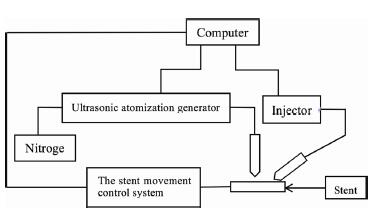
20171023160716 Figure 5 Principle of ultrasonic atomization spraying
[1]
Velat GJ, Hoh BL, Levy EI, Mocco J. Primary intracranial stenting in acute ischemic stroke. Curr Cardiol Rep, 2010, 12(1):14-19.
[2]
Mei MJ. Characteristics and clinical application of different types of cerebral vascular scaffolds. Chin J Tissue Eng Res, 2014, 18(25):4057-4061. (in Chinese)
[3]
Seo WK, Oh K, Suh SI, Seol HY. Intracranial stenting as a rescue therapy in patients with stroke-in-evolution. J Stroke Cerebrovasc Dis, 2016, 25(6):1411-1416.
[4]
Dotter CT, Judkins MP. Transluminal treatment of arteriosclerotic obstruction:description of a new technic and a preliminary report of its application. Circulation, 1964, 30(5):654-670
[5]
Fields JD, Liu KC, Barnwell SL, Clark WM, Lutsep HL. Indications and applications of arterial stents for stroke prevention in atherosclerotic intracranial stenosis. Curr Cardiol Rep, 2010, 12(1):20-28.
[6]
Taylor RA, Siddiq F, Suri MFK, Martin CO, Hayakawa M, Chaloupka JC. Risk factors for in-stent restenosis after vertebral ostium stenting. J Endovasc Ther, 2008, 15(2):203-212.
[7]
Hokimoto S, Tabata N, Yamanaga K, Sueta D, Akasaka T, Tsujita K, Sakamoto K, Yamamoto E, Yamamuro M, Izumiya Y, Kaikita K, Kojima S, Matsui K, Ogawa H. Prevalence of coronary macro-and micro-vascular dysfunctions after drug-eluting stent implantation without in-stent restenosis. Int J Cardiol, 2016, 222:185-194.
[8]
Mitra AK, Agrawal DK. In stent restenosis:bane of the stent era. J Clin Pathol, 2006, 59(3):232-239.
[9]
Vajda Z, Güthe T, Perez MA, Kurre W, Schmid E, Bäzner H, Henkes H. Prevention of intracranial in-stent restenoses:predilatation with a drug eluting balloon, followed by the deployment of a self-expanding stent. Cardiovasc Intervent Radiol, 2013, 36(2):346-352.
[10]
Zhang ZY, Yang SY. Endovascular stent and its materials science. J Clin Rehabilit Tissue Eng Res, 2011, 15(8):1471-1474. (in Chinese)
[11]
Liu DZ, Xi TF. Current situation and development tendency of Interventional medical device & material industry. China Med Dev Inform, 2006, 12(12):1-14. (in Chinese)
[12]
Agrawal CM, Haas KF, Leopold DA, Clark HG. Evaluation of poly (L-lactic acid) as a material for intravascular polymeric stents. Biomaterials, 1992, 13(3):176-182.
[13]
Wang CN, Gao RL, Cheng SJ, Song LF, Zheng JG, Zi ZY, Ruan YM, Meng L. Biocompatibility study of poly-D, L-lactide/glycolic acid coated coronary stent in porcine model. Chin J Cardiol, 2003, 31(7):528-531. (in Chinese)
[14]
Liu B, Li SM, Zhang JC, Shi YF. A novel stent coated with antibody against CD34 carried by the degradable polymer reduces restenosis in canine. Chin J Lab Diagn, 2007, 11(3):369-371. (in Chinese)
[15]
Zhou YH, Liao JH, Meng HY, Liu SH. Laser microfabrication of endovascular stent. Appl Laser, 2005, 25(3):161-164, 154. (in Chinese)
[16]
Gu XZ, Ni ZH. The fabrication of micro-hole stent by laser cutting. J Huazhong Univ Sci Technol (Nat Sci Ed), 2007, 35(S1):143-146. (in Chinese)
[17]
Ni ZH, Yi H, Gu XZ. Mechanism and method of drugloading Nano-particles and stent self-assembly. Chin J Mech Eng, 2005, 41(8):190-194. (in Chinese)
[18]
Henry M, Klonaris C, Amor M, Henry I, Tzvetanov K. State of the art:which stent for which lesion in peripheral interventions? Texas Heart Inst J, 2000, 27(2):119-126.
[19]
Hehrlein C. Promises of biodegradable stents. Catheter Cardiovasc Intervent, 2007, 69(5):739.
[20]
Yu ZT, Zhou L, Huang FQ, Yuan SB, Zhang YF, Niu JL, He XJ. R & D and application on Ti alloy capillary material used in vessel intervention. China Med Dev Inform, 2006, 12(12):15-20. (in Chinese)
[21]
Vajda Z, Aguilar M, Göhringer T, Horváth-Rizea D, Bäzner H, Henkes H. Treatment of intracranial atherosclerotic disease with a balloon-expandable paclitaxel eluting stent. Clin Neuroradiol, 2012, 22(3):227-233.
[22]
Janardhan V. Distal embolic protection devices with a variable thickness microguidewire and methods for their use. U.S. Patent 9,034,007, May 19, 2015.
 2017, Vol. 3