| Original Articles |
|


|
|
|
| Application of intraoperative O-arm-assisted real-time navigation technique for spinal fixation |
| Zhenxing Sun1, Dan Yuan2, Yaxing Sun3, Zhanquan Zhang4, Guihuai Wang1, Yi Guo1, Guoqin Wang1, Dongkang Liu1, Peng Chen1, Linkai Jing1, Feng Yang1, Peihai Zhang1, Huifang Zhang1, Youtu Wu1, Wei Shi1, James Wang1 |
1 Department of Neurosurgery, Changgung Hospital, Medical Center, Tsinghua University, Beijing 102218, China;
2 Department of Nephrology, Beijing Luhe Hospital, Capital Medical University, Beijing 101149, China;
3 Department of Psychiatry, Zaozhuang Mental Health Center, Zaozhuang 277103, China;
4 Department of Neurosurgery, The Fifth People's Hospital of Datong, Regional Medical Center Of Shanxi Province, Datong 037006, China |
|
|
|
|
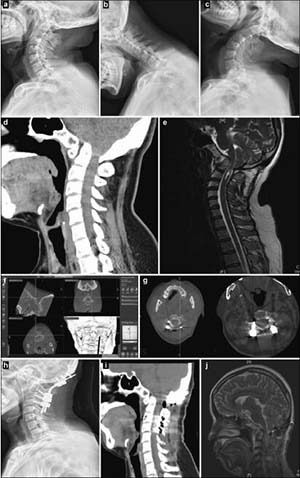
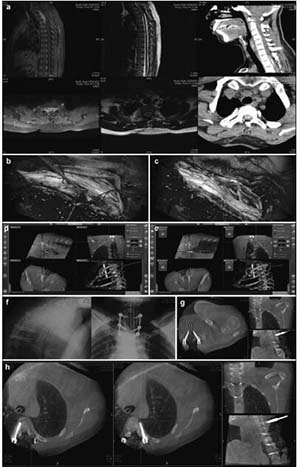
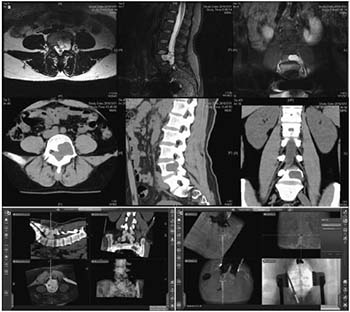
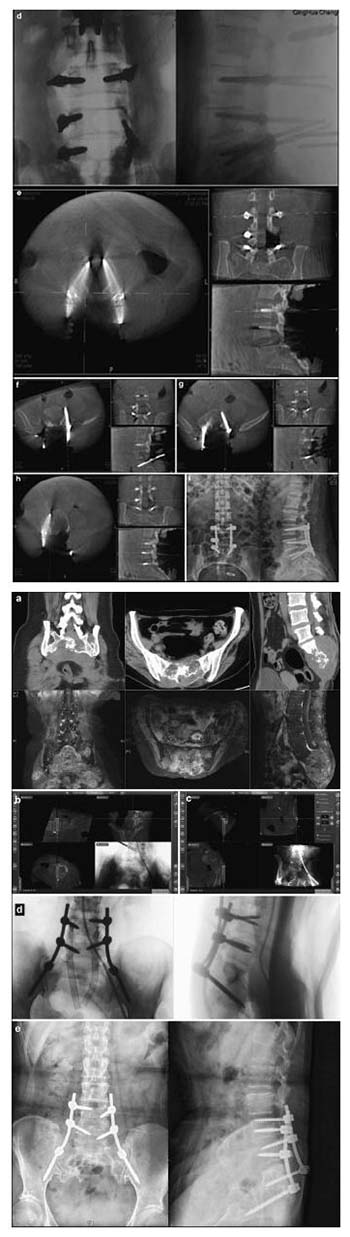
Abstract This study explored the combined use of the O-arm and real-time navigation during spinal fixation. The clinical data for 60 patients undergoing spinal fixation, at Beijing Tsinghua Chang Gung Hospital between May 5, 2015 and May 1, 2017, were retrospectively analyzed. Pre-, intra-, and postoperative imaging findings were assessed. The patients were classified into the occipitocervical fusion (32 cases) and thoracic/lumbar/sacral spine fixation (28 cases, including 6 cases of percutaneous pedicle screw) groups. Lesion resections were performed microscopically. An O-arm, combined with real-time navigation, was used to assess spinal fixation. Efficacy was evaluated using operative times, X-ray times, screw positioning, and complications. Within the occipitocervical fusion group, 182 screws were placed in the cervical spine and 96 in the occipital bone. However, 6 screws penetrated the bone cortex and were adjacent to the vertebral arteries, based on O-arm three-dimensional imaging; therefore, the precision rate was 96.7%. Within the thoracic/lumbar/sacral spine fixation group, 148 pedicle screws were implanted, with 4 initially outside the vertebral body, yielding a precision rate of 97.3%. Ten percutaneous pedicle screws were implanted and well positioned. O-arm scans were performed 3 times/patient, with an average of 20-30 min/time. Screw implantation times were 5-7 min (cervical spine), 8-10 min (thoracic spine), and 6-8 min (lumbar spine). Intraoperative O-arm scans, combined with real-time navigation technology, allow real-time observation of screw angles and depths, improving the accuracy and safety of posterior screw fixations and reducing the radiation dose and frequency experienced by patients and surgeons.
|
|
Received: 06 June 2017
Published: 30 September 2017
|
|
Corresponding Authors:
James Wang, E-mail:sunzhenxing0035@sina.com
E-mail: sunzhenxing0035@sina.com
|
|
Cite this article:
Zhenxing Sun, Dan Yuan, Yaxing Sun, Zhanquan Zhang, Guihuai Wang, Yi Guo, Guoqin Wang, Dongkang Liu, Peng Chen, Linkai Jing, Feng Yang, Peihai Zhang, Huifang Zhang, Youtu Wu, Wei Shi, James Wang. Application of intraoperative O-arm-assisted real-time navigation technique for spinal fixation. Translational Neuroscience and Clinics, 2017, 3(3): 135-146.
URL:
http://tnc.tsinghuajournals.com/10.18679/CN11-6030/R.2017.022 OR http://tnc.tsinghuajournals.com/Y2017/V3/I3/135
|
|
|
| [1] |
Odgers IV CJ, Vaccaro AR, Pollack ME, Cotler JM. Accuracy of pedicle screw placement with the assistance of lateral plain radiography. J Spinal Disord 1996, 9(4):334-338.
|
| [2] |
Roberts DW, Strohbehn JW, Hatch JF, Murray W, Kettenberger H. A frameless stereotaxic integration of computerized tomographic imaging and the operating microscope. J Neurosurg 1986, 65(4):545-549.
|
| [3] |
Steinmann JC, Herkowitz HN, El-Kommos H, Wesolowski DP. Spinal pedicle fixation. Confirmation of an image-based technique for screw placement. Spine 1993, 18(13):1856-1861.
|
| [4] |
Cong Y, Bao NR, Zhao JN, Mao GP. Comparing accuracy of cervical pedicle screw placement between a guidance system and manual manipulation:a cadaver study. Med Sci Monit 2015, 21:2672-2677.
|
| [5] |
Yang YL, Wang F, Han SM, Wang YH, Dong JL, Li LX, Zhou DS. Isocentric C-arm three-dimensional navigation versus conventional C-arm assisted C1-C2 transarticular screw fixation for atlantoaxial instability. Arch Orthop Trauma Surg 2015, 135(8):1083-1092.
|
| [6] |
Tao X, Tian W, Liu B, Li Q, Zhang G. Accuracy and complications of posterior C2 screw fixation using intraoperative three-dimensional fluoroscopy-based navigation. Chin Med J 2014, 127(14):2654-2658.
|
| [7] |
Laine T, Lund T, Ylikoski M, Lohikoski J, Schlenzka D. Accuracy of pedicle screw insertion with and without computer assistance:a randomized controlled clinical study in 100 consecutive patients. Eur Spine J 2000, 9(3):235-240.
|
| [8] |
Amiot LP, Lang K, Putzier M, Zippel H, Labelle H. Comparative results between conventional and computerassisted pedicle screw insertion in the thoracic, lumbar, and sacral spine. Spine (Phila Pa 1976), 2000, 25(5):606-614.
|
| [9] |
Bledsoe JM, Fenton D, Fogelson JL, Nottmeier EW. Accuracy of upper thoracic pedicle screw placement using threedimensional image guidance. Spine J 2009, 9(10):817-821.
|
| [10] |
Oertel MF, Hobart J, Stein M, Schreiber V, Scharbrodt W. Clinical and methodological precision of spinal navigation assisted by 3D intraoperative O-arm radiographic imaging. J Neurosurg Spine 2011, 14(4):532-536.
|
| [11] |
Baaj AA, Beckman J, Smith DA. O-arm-based image guidance in minimally invasive spine surgery:technical note. Clin Neurol Neurosurg 2013, 115(3):342-345.
|
| [12] |
Kosmopoulos V, Schizas C. Pedicle screw placement accuracy:a meta-analysis. Spine 2007, 32(3):E111-E120.
|
| [13] |
Lange J, Karellas A, Street J, Eck JC, Lapinsky A, Connolly PJ, Dipaola CP. Estimating the effective radiation dose imparted to patients by intraoperative cone-beam computed tomography in thoracolumbar spinal surgery. Spine 2013, 38(5):E306-E312.
|
| [14] |
Zhang J, Weir V, Fajardo L, Lin J, Hsiung H, Ritenour ER. Dosimetric characterization of a cone-beam O-arm Imaging system. J Xray Sci Technol 2009, 17(4):305-317.
|
|
Viewed |
|
|
|
Full text
|
|
|
|
|
Abstract
|
|
|
|
|
Cited |
|
|
|
|
| |
Shared |
|
|
|
|
| |
Discussed |
|
|
|
|