1 School of Materials Science and Engineering, Tsinghua University, Beijing 100084, China;
2 Beijing Allgens Medical Science and Technology Co., Ltd., Beijing 100176, China;
3 Department of Neurosurgery, Tsinghua University Yuquan Hospital, Beijing 100040, China
Biodegradable mineralized collagen plug for the reconstruction of craniotomy burr-holes: A report of three cases
1 School of Materials Science and Engineering, Tsinghua University, Beijing 100084, China;
2 Beijing Allgens Medical Science and Technology Co., Ltd., Beijing 100176, China;
3 Department of Neurosurgery, Tsinghua University Yuquan Hospital, Beijing 100040, China
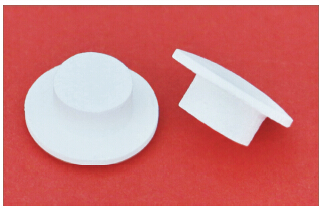
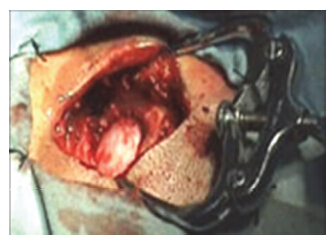
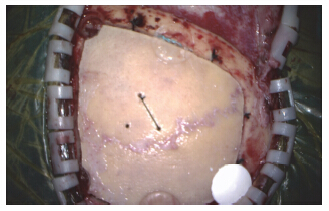
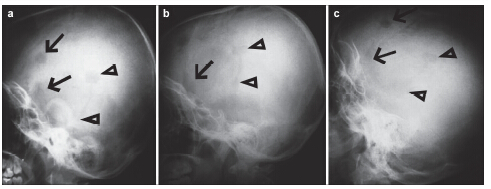
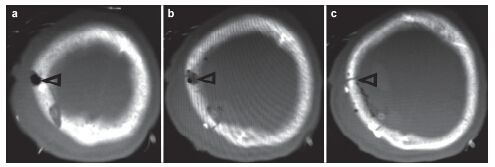
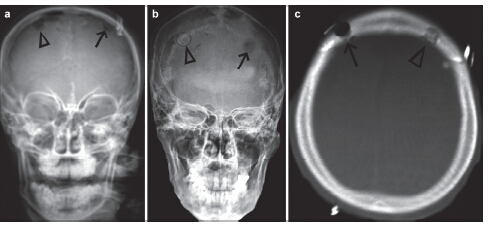
摘要 Objectives: In this case report, we describe the design, fabrication and clinical outcomes of a novel bioresorbable, mineralized collagen burr-hole plug for the reconstruction of craniotomy burr-holes. Methods: Mineralized collagen burr-hole plugs were fabricated via a biomimetic mineralization process. The biomimetic mineralized collagen has a similar chemical composition and microstructure to natural bone tissue, thereby possessing good biocompatibility and osteoconductivity. The mineralized collagen burr-hole plugs were implanted into three patients, and clinical outcomes were evaluated at one-year follow-ups. Results: All bone defects healed very well using the mineralized collagen burr-hole plugs, and there were no adverse reactions at the surgical sites. Conclusions: The clinical outcomes indicated that the mineralized collagen was effective for reconstructing burr-holes in the skull after craniotomy.
Abstract: Objectives: In this case report, we describe the design, fabrication and clinical outcomes of a novel bioresorbable, mineralized collagen burr-hole plug for the reconstruction of craniotomy burr-holes. Methods: Mineralized collagen burr-hole plugs were fabricated via a biomimetic mineralization process. The biomimetic mineralized collagen has a similar chemical composition and microstructure to natural bone tissue, thereby possessing good biocompatibility and osteoconductivity. The mineralized collagen burr-hole plugs were implanted into three patients, and clinical outcomes were evaluated at one-year follow-ups. Results: All bone defects healed very well using the mineralized collagen burr-hole plugs, and there were no adverse reactions at the surgical sites. Conclusions: The clinical outcomes indicated that the mineralized collagen was effective for reconstructing burr-holes in the skull after craniotomy.
基金资助: This work was supported in part by the National Basic Research Program (973 Program) of China (No. 2011CB606205), the “Twelfth Five-Year” National Science and Technology Support Program (No. 2012BAI17B02) funded by the Ministry of Science and Technology of China, and the National Natural Science Fund funded by the National Natural Science Foundation of China (Nos. 21371106 and 51402167).
Zhiye Qiu, Yuqi Zhang, Ziqiang Zhang, Tianxi Song, Fuzhai Cui. Biodegradable mineralized collagen plug for the reconstruction of craniotomy burr-holes: A report of three cases[J]. 临床转化神经科学, 2015, 1(1): 3-9.
Zhiye Qiu, Yuqi Zhang, Ziqiang Zhang, Tianxi Song, Fuzhai Cui. Biodegradable mineralized collagen plug for the reconstruction of craniotomy burr-holes: A report of three cases. Translational Neuroscience and Clinics, 2015, 1(1): 3-9.
Easwer HV, Rajeev A, Varma HK, Vijayan S, Bhattacharya RN. Cosmetic and radiological outcome following the use of synthetic hydroxyapatite porous-dense bilayer burr-hole buttons. Acta Neurochir (Wien) 2007, 149(5): 481-486.
[2]
Dujovny M, Dujovny N, Viñas F, Park HK, Lopez F. Burr hole cover for ventriculoperitoneal shunts and ventriculostomy: technical note. Neurol Res 2002, 24(5): 483-484.
[3]
Dujovny M, Aviles A, Cuevas P. Bone-like polyethelyne burr-hole cover. Neurol Res 2005, 27(3): 333-334.
[4]
Boström S, Kourtopoulos H, Nilsson I. Reconstruction of craniotomy burr-holes with autologous bone blugs made by a new hole-saw. Acta Neurochir (Wien) 1990, 105(3-4): 132-134.
[5]
Cokluk C, Senel A, Iyigün O, Aydin K, Rakunt C, Celik F. Reconstruction of burr hole by using autologous buttonshaped graft harvested from inner table of craniotomy flap: Technique and clinical result. Minim Invasive Neurosurg 2003, 46(6): 372-373.
[6]
Matsumoto K, Kohmura E, Kato A, Hayakawa T. Restoration of small bone defects at craniotomy using autologous bone dust and fibrin glue. Surg Neurol 1998, 50(4): 344-346.
[7]
Dorozhkin SV. Bioceramics of calcium orthophosphates. Biomaterials 2010, 31(7): 1465-1485.
[8]
Guo BL, Lei B, Li P, Ma PX. Functionalized scaffolds to enhance tissue regeneration. Regen Biomater 2015, 2(1): 47-57.
[9]
Hammouche S, Hammouche D, McNicholas M. Biodegradable bone regeneration synthetic scaffolds: In tissue engineering. Curr Stem Cell Res Ther 2012, 7(2): 134-142.
[10]
Goh DH, Kim GJ, Park J. Medporcraniotomy gap wedge designed to fill small bone defects along cranial bone flap. J Korean Neurosurg Soc 2009, 46(3): 195-198.
[11]
Koyama J, Hongo K, Iwashita T, Kobayashi S. A newly designed key-hole button. J Neurosurg 2000, 93(3): 506-508.
[12]
Kashimura H, Ogasawara K, Kubo Y, Yoshida K, Sugawara A, Ogawa A. A newly designed hydroxyapatite ceramic burrhole button. Vasc Health Risk Manag 2010, 6: 105-108.
[13]
Schantz JT, Lim TC, Ning C, Teoh SH, Tan KC, Wang SC, Hutmacher DW. Cranioplasty after trephination using a novel biodegradable burr hole cover: Technical case report. Neurosurgery 2006, 58(1): ONS-E176.
[14]
Low SW, Ng YJ, Yeo TT, Chou N. Use of Osteoplug polycaprolactone implants as novel burr-hole covers. Singapore Med J 2009, 50(8): 777-780.
[15]
Winkler PA, Herzog C, Weiler C, Krishnan KG. Foreignbody reaction to silastic burr-hole covers with seroma formation: case report and review of the literature. Pathol Res Pract 2000, 196(1): 61-66.
[16]
Liao SS, Cui FZ. In vitro and in vivo degradation of mineralized collagen-based composite scaffold: nanohydroxyapatite/collagen/poly(L-lactide). Tissue Eng 2004, 10(1-2): 73-80.
[17]
Liao SS, Guan K, Cui FZ, Shi SS, Sun TS. Lumbar spinal fusion with a mineralized collagen matrix and rhBMP-2 in a rabbit model. Spine (Phila Pa 1976) 2003, 28(17): 1954-1960.
[18]
Liao SS, Cui FZ, Zhang W, Feng QL. Hierarchically biomimetic bone scaffold materials: Nano-HA/collagen/PLA composite. J Biomed Mater Res B Appl Biomater 2004, 69(2): 158-165.
[19]
Huh J. Burr hole drainage: could be another treatment option for cerebrospinal fluid leakage after unidentified dural tear during spinal surgery? J Korean Neurosurg Soc 2013, 53(1): 59-61.
[20]
Sciubba DM, Kretzer RM, Wang PP. Acute intracranial subdural hematoma following a lumbar CSF leak caused by spine surgery. Spine (Phila Pa 1976) 2005, 30(24): E730- E732.
[21]
Plum AW, Tatum SA. A comparison between autograft alone, bone cement, and demineralized bone matrix in cranioplasty. Laryngoscope 2015, 125(6): 1322-1327.
Sorour M, Caton WL, Couldwell WT. Technique for methyl methacrylate cranioplasty to optimize cosmetic outcome. Acta Neurochir (Wien) 2014, 156(1): 207-209.
[24]
Dujovny M, Aviles A, Agner C, Fernandez P, Charbel FT. Cranioplasty: cosmetic or therapeutic? Surg Neurol 1997, 47(3): 238-241.
[25]
Grantham EC, Landis HP. Cranioplasty and the posttraumatic syndrome. J Neurosurg 1948, 5(1): 19-22.
[26]
Ohata K, Haque M, Tsuruno T, Morino M, Soares SBJ, Hakuba A. Craniotomy repair with titanium miniplates. J Clin Neurosci 1998, 5(1): 81-86.
[27]
Yamashima T. Reconstruction of surgical skull defects with hydroxylapatite ceramic buttons and granules. Acta Neurochir (Wien) 1988, 90(3-4): 157-162.
[28]
Timoney PJ, Clark JD, Frederick PA, Krakauer M, Compton C, Horbinski C, Spkol J, Nunery WR. Foreign body granuloma following orbital reconstruction with porous polyethylene. Ophthal Plast Reconstr Surg 2014, DOI: 10.1097/IOP.0000000000000328.
[29]
Spaans AJ, van Heeswijk EJM, Arnold DE, Beumer A. Foreign body reaction associated with polyethylene mesh interposition used for treatment of trapeziometacarpal osteoarthritis: Report of 8 cases. J Hand Surg 2014, 39(10): 2016-2019.
[30]
Gosau M, Draenert FG, Ihrler S. Facial augmentation with porous polyethylene (Medpor)—Histological evidence of intense foreign body reaction. J Biomed Mater Res B Appl Biomater 2008, 87(1): 83-87.
[31]
Ducic Y. Titanium mesh and hydroxyapatite cement cranioplasty: a report of 20 cases. J Oral Maxillofac Surg 2002, 60(3): 272-276.
[32]
Heggers JP, Kossovsky N, Parsons RW, Robson MC, Pelley RP, Raine TJ. Biocompatibility of silicone implants. Ann Plast Surg 1983, 11(1): 38-45.
[33]
VandeVord PJ, Gupta N, Wilson RB, Vinuya RZ, Schaefer CJ, Canady AI, Wooley PH. Immune reactions associated with silicone-based ventriculo-peritoneal shunt malfunctions in children. Biomaterials 2004, 25(17): 3853-3860.
[34]
Berner A, Woodruff MA, Lam CXF, Arafat MT, Saifzadeh S, Steck R, Ren J, Nerlich M, Ekaputra AK, Gibson I, et al. Effects of scaffold architecture on cranial bone healing. Int J Oral Maxillofac Surg 2014, 43(4): 506-513.
[35]
Coombes AGA, Rizzi SC, Williamson M, Barralet JE, Downes S, Wallace WA. Precipitation casting of polycaprolactone for applications in tissue engineering and drug delivery. Biomaterials 2004, 25(2): 315-325.
[36]
Woodruff MA, Hutmacher DW. The return of a forgotten polymer-Polycaprolactone in the 21st century. Prog Polym Sci 2010, 35(10): 1217-1256.
[37]
Worm PV, Ferreira NP, Faria MB, Ferreira MP, Kraemer JL, Collares MVM. Comparative study between cortical bone graft versus bone dust for reconstruction of cranial burr holes. Surg Neurol Int 2010, 1: 91.
[38]
Betz RR. Limitations of autograft and allograft: new synthetic solutions. Orthopedics 2002, 25(5 Suppl): S561-S570.
[39]
Cui FZ, Li Y, Ge J. Self-assembly of mineralized collagen composites. Mater Sci Engineer: R: Rep 2007, 57(1-6): 1-27.
[40]
Du C, Cui FZ, Zhu XD, de Groot K. Three-dimensional nano-HAp/collagen matrix loading with osteogenic cells in organ culture. J Biomed Mater Res 1999, 44(4): 407-415.
[41]
Xia Y, Peng SS, Xie LZ, Lian XJ, Zhang XJ, Cui H, Song TX, Zhang FM, Gu N, Cui FZ. A novel combination of nanoscaffolds with micro-scaffolds to mimic extracellularmatrices improve osteogenesis. J Biomater Appl 2013, 29(1): 59-71.
[42]
Yu X, Xu L, Cui FZ, Qu Y, Lian XJ, Wang XM, Wang Y. Clinical evaluation of mineralized collagen as a bone graft substitute for anterior cervical intersomatic fusion. J Biomater Tissue Engineer 2012, 2(2): 170-176.
[43]
Lian K, Lu H, Guo XD, Cui FZ, Qiu ZY, Xu SY. The mineralized collagen for the reconstruction of intra-articular calcaneal fractures with trabecular defects. Biomatter 2013, 3(4): e272850.
[44]
Kou JM, Fu TY, Jia XJ, Hou JW, Gao C, Ma YZ, Qiu ZY, Cui FZ. Clinical observations on repair of non-infected bone nonunion by using mineralized collagen graft. J Biomater Tissue Engineer 2014, 4(12): 1107-1112.
 2015, Vol. 1