Effect of heparin on the expressions of serum intercellular adhesion molecule-1 and hippocampus S100β protein after cardiopulmonary resuscitation in rabbits
1. Department of Anesthesia, Ningxia People's hospital, Yinchuan 750002, China;
2. The First Clinical Medical College of Northwest University for Nationalities, Yinchuan 750002, China
Effect of heparin on the expressions of serum intercellular adhesion molecule-1 and hippocampus S100β protein after cardiopulmonary resuscitation in rabbits
1. Department of Anesthesia, Ningxia People's hospital, Yinchuan 750002, China;
2. The First Clinical Medical College of Northwest University for Nationalities, Yinchuan 750002, China
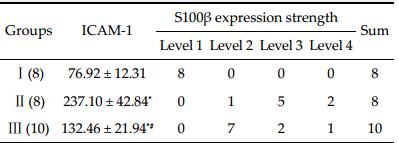
摘要 Objective: Use heparin during cardiac arrest (CA) in rabbits and observe the serum intercellular adhesion molecule-1 (ICAM-1) and hippocampal S100β protein expressions after cardiopulmonary resuscitation (CPR). Methods: Thirty-two New Zealand rabbits were randomly divided into, Group I, control group; Group II, saline group; Group III, heparin group. Each animal underwent continuous hemodynamic monitoring including mean arterial pressure (MBP), heart rate (HR), and the end-tidal carbon dioxide partial pressure (PetCO2). Twenty-four hours after resuscitation, serum and hippocampal neurons were collected from all animals. Enzyme linked immunosorbent assay was used to detect serum ICAM-1 and immunohistochemistry to detect the S100β protein in hippocampal neurons. According to the rate of positive cells, each hippocampal specimen was categorized into four expression levels. Results: The differences in the serum ICAM-1 concentration in the three groups were statistically significant. The expression of S100β protein in the hippocampus showed eight cases in group I at level 1 and none in groups II and III. There was 1 case in group II and 7 cases in group III at level 2; five cases in group II and 2 cases in group III at level 3; 2 cases in group II and 1 case in group III at level 4. The expression strength of S100β protein in the three groups differed significantly (P < 0.05). Conclusions: Heparin therapy can reduce the expression of serum ICAM-1 and S100β protein in hippocampal neurons during CPR. It is possible that heparin can have a positive effect on brain protection during CPR.
Abstract: Objective: Use heparin during cardiac arrest (CA) in rabbits and observe the serum intercellular adhesion molecule-1 (ICAM-1) and hippocampal S100β protein expressions after cardiopulmonary resuscitation (CPR). Methods: Thirty-two New Zealand rabbits were randomly divided into, Group I, control group; Group II, saline group; Group III, heparin group. Each animal underwent continuous hemodynamic monitoring including mean arterial pressure (MBP), heart rate (HR), and the end-tidal carbon dioxide partial pressure (PetCO2). Twenty-four hours after resuscitation, serum and hippocampal neurons were collected from all animals. Enzyme linked immunosorbent assay was used to detect serum ICAM-1 and immunohistochemistry to detect the S100β protein in hippocampal neurons. According to the rate of positive cells, each hippocampal specimen was categorized into four expression levels. Results: The differences in the serum ICAM-1 concentration in the three groups were statistically significant. The expression of S100β protein in the hippocampus showed eight cases in group I at level 1 and none in groups II and III. There was 1 case in group II and 7 cases in group III at level 2; five cases in group II and 2 cases in group III at level 3; 2 cases in group II and 1 case in group III at level 4. The expression strength of S100β protein in the three groups differed significantly (P < 0.05). Conclusions: Heparin therapy can reduce the expression of serum ICAM-1 and S100β protein in hippocampal neurons during CPR. It is possible that heparin can have a positive effect on brain protection during CPR.
Wenxun Liu, Yun Wang, Xiaohong Zhou, Wenjuan Cheng, Qingshan Ye. Effect of heparin on the expressions of serum intercellular adhesion molecule-1 and hippocampus S100β protein after cardiopulmonary resuscitation in rabbits[J]. 临床转化神经科学, 2016, 2(4): 227-230.
Wenxun Liu, Yun Wang, Xiaohong Zhou, Wenjuan Cheng, Qingshan Ye. Effect of heparin on the expressions of serum intercellular adhesion molecule-1 and hippocampus S100β protein after cardiopulmonary resuscitation in rabbits. Translational Neuroscience and Clinics, 2016, 2(4): 227-230.
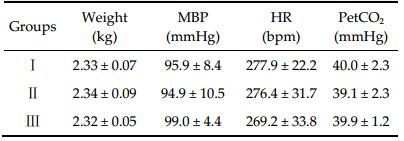
20170308101456 Table 1 Basic vital signs of the three animal groups
20170308101557 Table 2 ICAM-1 and S100β expression after recovery
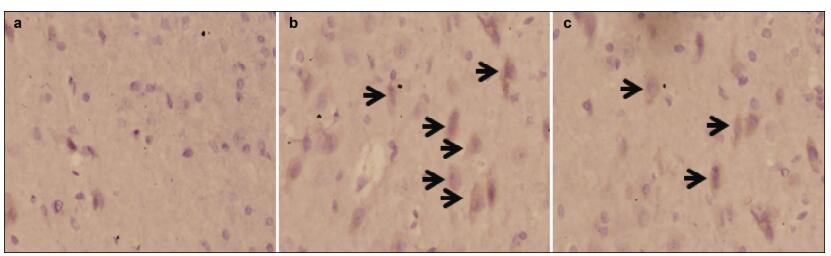
20170308101619 Figure 1 Immunohistochemical analysis of S100 β expression in the different groups. a Sham group. b Saline group. c Heparin group.
[1]
Beurskens CJ, Horn J, de Boer AM, Schultz MJ, van Leeuwen EM, Vroom MB, Juffermans NP. Cardiac arrest patients have an impaired immune response, which is not influenced by induced hypothermia. Crit Care 2014, 18(4): R162.
[2]
Kelm RF, Wagenführer J, Bauer H, Schmidtmann I, Engelhard K, Noppens RR. Effects of levosimendan on hemodynamics, local cerebral blood flow, neuronal injury, and neuroinflammation after asphyctic cardiac arrest in rats. Crit Care Med 2014, 42(6): e410-e419.
[3]
Chakraborty S, Núñez D, Hu SY, Domingo MP, Pardo J, Karmenyan A, Eva Ma Gálvez, Chiou A. FRET based quantification and screening technology platform for the interactions of leukocyte function-associated antigen-1(LFA-1) with intercellular adhesion molecule-1(ICAM-1). PLoS One 2014, 9(7): e102572.
Mulloy B, Hogwood J, Gray E, Lever R, Page CP. Pharmacology of heparin and related drugs. Pharmacol Rev 2016, 68(1): 76-141.
[6]
Ye QS, Wang LL, Wang JK, Shi WZ, Liu H, Han HW, Ma ZF, Hai KR. Evaluation of a rat model of asphyxial cardiac arrest and cardiopulmonary resuscitation. Chin J Anesthesiol 2008, 28(8): 750-752. (in Chinese)
[7]
Tang HP, Sun LX, Han W. Endothelial cells on the proliferation and of intercellular adhesion molecule 1 and interleukin 8 of vascular smooth muscle cells. Genet Mol Res 2013, 12(4): 4363-4370.
[8]
Yao B, Zhang LN, Ai YH, Liu ZY, Huang L. Serum S100β is a better biomarker than neuron-specific enolase for sepsis-associated encephalopathy and determining its prognosis: A prospective and observational study. Neurochem Res 2014, 39(7): 1263-1269.
[9]
Cheong KA, Noh M, Kim CH, Lee AY. S100B as a potential biomarker for the detection of cytotoxicity of melanocytes. Exp Dermatol 2014, 23(3): 165-171.
 2016, Vol. 2