| Original Articles |
|


|
|
|
| Surgical treatment of brainstem cavernous malformations with three basic skull base approaches and minimally invasive techniques:Observations in 20 patients |
| Wen Yin, Jianrong Ma, Yiwei Liao |
| Department of Neurosurgery, Xiangya Hospital, Central South University, Changsha 410008, China |
|
|
|
|
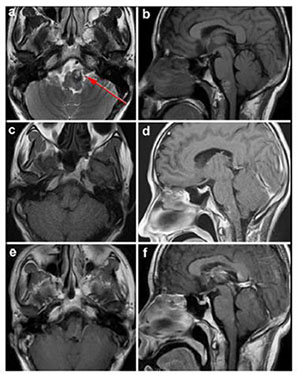
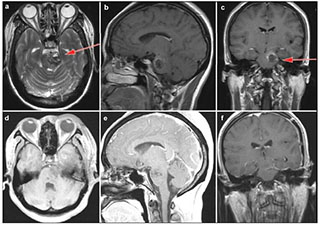
Abstract Objective: Brainstem cavernous malformation (BSCM) is extremely challenging for neurosurgeons in terms of surgical approach choices.In this article,we summarized our experience in skull base approaches of BSCM,and elucidated the advance of surgical treatments of brain stem cavernous malformation through reviewing recent relevant articles.
Methods: We retrospectively reviewed 20 consecutive patients who underwent resection between May 1,2014 and April 30,2016.Only midline suboccipital,subtemporal approach and retrosigmoid approach were used in this series.The diagnoses of all patients were confirmed by radiological and histological examination.
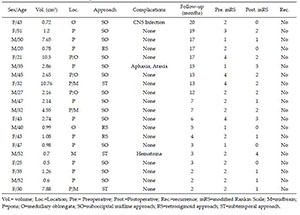
Results: All 20 patients were completely extirpated without surgical-related mortality.The mean follow-up period was 9.5 months (range,2-20 months).Of the 20 patients,80% symptomatic patients underwent surgery after first bleeding episode within 3 months,20% after two or more bleeding episodes by magnetic resonance imaging.After resection and during follow-up,75% of patients had an improvement in their modified Rankin scale (mRS) scores,whereas 10% were worse compared with their preoperative presentation;15% were unchanged.
Conclusion: Appropriate basic surgical approach and minimally invasive techniques are necessary in preventing impairment of neurologic function.The three common basic skull base approaches,combined with minimally invasive techniques can handle most of BSCMs with good surgical results.
|
|
Received: 20 February 2017
Published: 30 June 2017
|
|
Corresponding Authors:
Yiwei Liao,E-mail:yiweiliao2014@hotmail.com
E-mail: yiweiliao2014@hotmail.com
|
|
|
| [1] |
Cantu C, Murillo-Bonilla L, Arauz A, Higuera J, Padilla J, Barinagarrementeria F. Predictive factors for intracerebral hemorrhage in patients with cavernous angiomas. Neurol Res 2005, 27(3):314-318.
|
| [2] |
Chen L, Zhao Y, Zhou L, Zhu W, Pan Z, Mao Y. Surgical strategies in treating brainstem cavernous malformations. Neurosurgery 2011, 68(3):609-620.
|
| [3] |
Gross BA, Batjer HH, Awad IA, Bendok BR, Du R. Brainstem cavernous malformations:1390 surgical cases from the literature. World Neurosurg 2013, 80(1-2):89-93.
|
| [4] |
Kim DS, Park YG, Choi JU, Chung SS, Lee KC. An analysis of the natural history of cavernous malformations. Surg Neurol 1997, 48(1):9-17.
|
| [5] |
Abla AA, Lekovic GP, Turner JD, de Oliveira JG, Porter R, Spetzler RF. Advances in the treatment and outcome of brainstem cavernous malformation surgery:A single-center case series of 300 surgically treated patients. Neurosurgery 2011, 68(2):403-414.
|
| [6] |
El Ahmadieh TY, Aoun SG, Bendok BR, Batjer HH. Management of brainstem cavernous malformations. Curr Treat Options Cardiovasc Med 2012, 14(3):237-251.
|
| [7] |
Gross BA, Batjer HH, Awad IA, Bendok BR. Brainstem cavernous malformations. Neurosurgery 2009, 64(5):E805-818.
|
| [8] |
Abla AA, Spetzler RF. Brainstem cavernoma surgery:The state of the art. World Neurosurg 2013, 80(1-2):44-46.
|
| [9] |
Bogucki J, Czernicki Z, Gielecki J. Cytoarchitectonic basis for safe entry into the brainstem. Acta Neurochir (Wien) 2000, 142(4):383-387.
|
| [10] |
Kumar A, Sharma R, Garg A, Sharma BS. Contralateral anterior interhemispheric transparaterminal gyrus approach for thalamopeduncular pilocytic astrocytoma in an adult:Technical report. World Neurosurg 2016, 87:21-25.
|
| [11] |
Recalde RJ, Figueiredo EG, de Oliveira E. Microsurgical anatomy of the safe entry zones on the anterolateral brainstem related to surgical approaches to cavernous malformations. Neurosurgery 2008, 62(3 Suppl 1):9-15.
|
| [12] |
Francois P, Ben Ismail M, Hamel O, Bataille B, Jan M, Velut S. Anterior transpetrosal and subtemporal transtentorial approaches for pontine cavernomas. Acta Neurochir (Wien) 2010, 152(8):1321-1329.
|
| [13] |
Rankin J. Cerebral vascular accidents in patients over the age of 60. Ⅲ. Diagnosis and treatment. Scott Med J 1957, 2(6):254-268.
|
| [14] |
Abla AA, Lekovic GP, Garrett M, Wilson DA, Nakaji P, Bristol R, Spetzler RF. Cavernous malformations of the brainstem presenting in childhood:Surgical experience in 40 patients. Neurosurgery 2010, 67(6):1589-1598.
|
| [15] |
de Oliveira JG, Lekovic GP, Safavi-Abbasi S, Reis CV, Hanel RA, Porter RW, Preul MC, Spetzler RF. Supracerebellar infratentorial approach to cavernous malformations of the brainstem:surgical variants and clinical experience with 45 patients. Neurosurgery 2010, 66(2):389-399.
|
| [16] |
Sanborn MR, Kramarz MJ, Storm PB, Adappa ND, Palmer JN, Lee JY. Endoscopic, endonasal, transclival resection of a pontine cavernoma:case report. Neurosurgery 2012, 71(1 Suppl Operative):198-203.
|
| [17] |
Chen LH, Zhang HT, Chen L, Liu LX, Xu RX. Minimally invasive resection of brainstem cavernous malformations:Surgical approaches and clinical experiences with 38 patients. Clin Neurol Neurosurg 2014, 116:72-79.
|
| [18] |
Aiba T, Tanaka R, Koike T, Kameyama S, Takeda N, Komata T. Natural history of intracranial cavernous malformations. J Neurosurg 1995, 83(1):56-59.
|
| [19] |
Almefty KK, Spetzler RF. Management of brainstem cavernous malformations. World Neurosurg 2015, 83(3):317-319.
|
| [20] |
Chotai S, Qi S, Xu S. Prediction of outcomes for brainstem cavernous malformation. Clin Neurol Neurosurg 2013, 115(10):2117-2123.
|
| [21] |
Sekhar LN, Mantovani A. Surgical approaches to brain stem cavernous hemangiomas. World Neurosurg 2014, 82(6):1028-1029.
|
| [22] |
Mussi AC, Rhoton AL, Jr. Telovelar approach to the fourth ventricle:Microsurgical anatomy. J Neurosurg 2000, 92(5):812-823.
|
| [23] |
Giliberto G, Lanzino DJ, Diehn FE, Factor D, Flemming KD, Lanzino G. Brainstem cavernous malformations:Anatomical, clinical, and surgical considerations. Neurosurgical focus 2010, 29(3):E9.
|
| [24] |
Steno J, Bizik I, Stenova J, Timarova G. Subtemporal transtentorial resection of cavernous malformations involving the pyramidal tract in the upper pons and mesencephalon. Acta Neurochir (Wien) 2011, 153(10):1955-1962.
|
| [25] |
Sabatino G, Rigante L, Marchese E, et al. Anterior subtemporal approach for posterolateral brainstem cavernomas:report of ten cases. Acta Neurochir (Wien) 2012, 154(11):2009-2016.
|
| [26] |
Yagmurlu K, Rhoton AL, Jr., Tanriover N, Bennett JA. Three-dimensional microsurgical anatomy and the safe entry zones of the brainstem. Neurosurgery 2014, 10(Suppl 4):602-619.
|
| [27] |
Wang CC, Liu A, Zhang JT, Sun B, Zhao YL. Surgical management of brain-stem cavernous malformations:Report of 137 cases. Surg Neurol 2003, 59(6):444-454.
|
| [28] |
Mai JC, Ramanathan D, Kim LJ, Sekhar LN. Surgical resection of cavernous malformations of the brainstem:Evolution of a minimally invasive technique. World Neurosurg 2013, 79(5-6):691-703.
|
| [29] |
Abla AA, Benet A, Lawton MT. The far lateral transpontomedullary sulcus approach to pontine cavernous malformations:Technical report and surgical results. Neurosurgery 2014,10(Suppl 3):472-480.
|
| [30] |
Yasargil MG, Reichman MV, Kubik S. Preservation of the frontotemporal branch of the facial nerve using the interfascial temporalis flap for pterional craniotomy. Technical article. J Neurosurg 1987, 67(3):463-466.
|
| [31] |
Hu P, Liang J, Bao Y, Li M, Ling F. The pterional transsylvian transtentorial approach to ventrolateral pontine cavernomas:Indications and techniques. World Neurosurg 2014, 82(6):1276-1282.
|
| [32] |
Asaad WF, Walcott BP, Nahed BV, Ogilvy CS. Operative management of brainstem cavernous malformations. Neurosurg Focus 2010, 29(3):E10.
|
| [33] |
Abla AA, Spetzler RF. Minimally invasive, but not at the cost of maximally effective, in the surgical removal of brainstem cavernous malformations. World Neurosurg 2013, 79(5-6):638-640.
|
| [34] |
Linsler S, Oertel J. Endoscopic endonasal transclival resection of a brainstem cavernoma:A detailed account of our technique and comparison with the literature. World Neurosurg 2015, 84(6):2064-2071.
|
|
Viewed |
|
|
|
Full text
|
|
|
|
|
Abstract
|
|
|
|
|
Cited |
|
|
|
|
| |
Shared |
|
|
|
|
| |
Discussed |
|
|
|
|