| Short Communications |
|


|
|
|
| Subarachnoid hemorrhage after surgery of the medulla oblongata hemangioblastoma: A case report |
| Xiang Yang, Yuekang Zhang, Xuesong Liu, Maojun Chen |
| Department of Neurosurgery, West China Hospital of Sichuan University, Chengdu 610041, China |
|
|
|
|
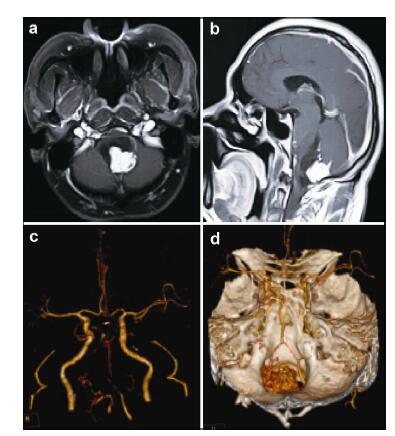
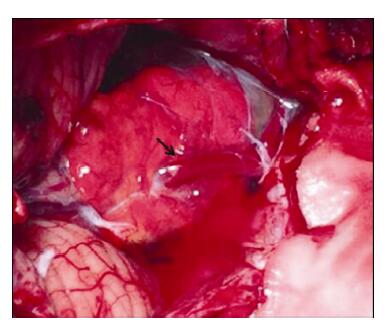
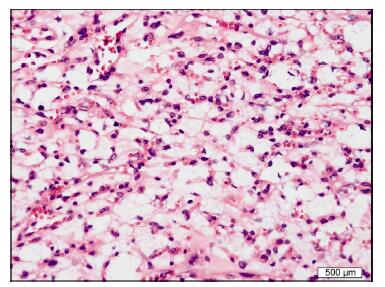
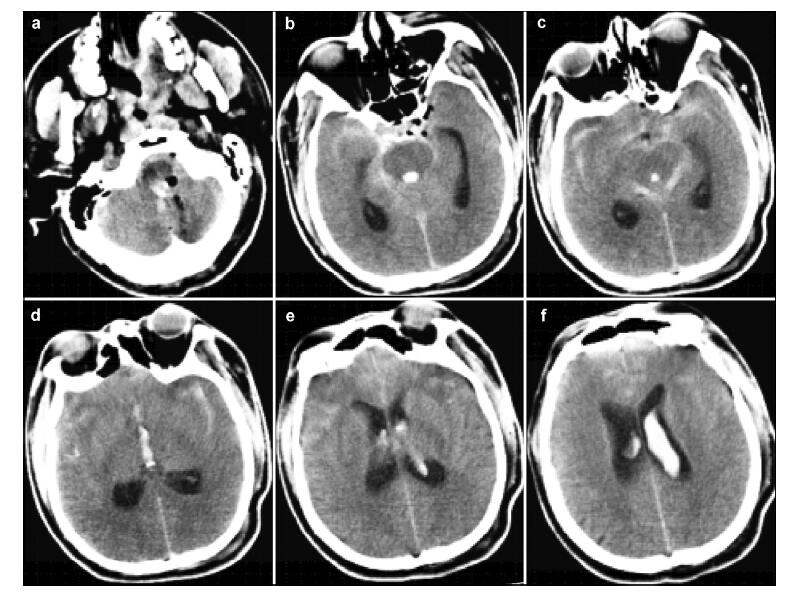
Abstract Objectives: To discuss the bleeding mechanisms after removing a medulla oblongata hemangioblastoma. Methods: A 42-year-old male patient was diagnosed with a medulla oblongata hemangioblastoma. Preoperative cranial magnetic resonance imaging, computed tomography angiography and post-surgery computed tomography were completed during clinical procedure. We also reviewed the related literatures. Results: The preoperative computed tomography angiography did not demonstrate any intracranial aneurysm. But, the patient had a fatal subarachnoid hemorrhage with ventricular hemorrhage 4 hours after surgery following the post-surgery computed tomography. Conclusions: Subarachnoid hemorrhage after surgery of the medulla oblongata hemangioblastoma is very rare. Delayed postoperative hemorrhage seems the most reasonable explanation of Subarachnoid hemorrhage in our case.
|
|
Received: 25 April 2016
Published: 30 September 2016
|
|
Corresponding Authors:
Maojun Chen, E-mail:446580884@qq.com
E-mail: 446580884@qq.com
|
|
|
[1] Pavesi G, Berlucchi S, Munari M, Manara R, Scienza R, Opocher G. Clinical and surgical features of lower brain stem hemangioblastomas in von Hippel-Lindau disease. Acta Neurochir (Wien) 2010, 152(2):287-292.
[2] Gläsker S, Van Velthoven V. Risk of hemorrhage in heman-gioblastomas of the central nervous system. Neurosurgery 2005, 57(1):71-76.
[3] Fujii H, Higashi S, Hashimoto M, Shouin K, Hayase H, Kimura M, Yamamoto S. Hemangioblastoma presenting with fourth ventricular bleeding. Case report. Neurol Med Chir (Tokyo) 1987, 27(6):545-549.
[4] Ros de San Pedro J, Rodríguez FA, Ñíguez BF, Sánchez JFML, López-Guerrero AL, Murcia MF, Vilar AMRE. Massive hemorrhage in hemangioblastomas. Neurosurg Rev 2010, 33(1):11-26.
[5] Kallmes DF, Layton K, Marx WF, Tong F. Death by nondiagnosis:Why emergent CT angiography should not be done for patients with subarachnoid hemorrhage. Am J Neuroradiol 2007, 28(10):1837-1838.
[6] Sharma MS, Jha AN. Ruptured intracranial aneurysm associated with von Hippel-Lindau syndrome:A molecular link? J Neurosurg 2006, 104(2):90-93.
[7] Klingler JH, Krüger MT, Lemke JR, Jilg C, Van Velthoven V, Zentner J, Neumann HPH, Gläsker S. Sequence variations in the von Hippel-Lindau tumor suppressor gene in patients with intracranial aneurysms. J Stroke Cerebrovasc Dis 2013, 22(4):437-443.
[8] Chun YI, Cho J, Moon CT, Koh YC. Delayed fatal cerebellar hemorrhage caused by hemangioblastoma after successful radiosurgical treatment. Acta Neurochir (Wien) 2010, 152(9):1625-1627.
[9] Gekka M, Yamaguchi S, Kazumata K, Kobayashi H, Motegi H, Terasaka S, Houkin K. Hemorrhagic onset of hemangioblastoma located in the dorsal medulla oblongata presenting with tako-tsubo cardiomyopathy and neurogenic pulmonary edema:A case report. Case Rep Neurol 2014, 6(1):68-73. |
|
Viewed |
|
|
|
Full text
|
|
|
|
|
Abstract
|
|
|
|
|
Cited |
|
|
|
|
| |
Shared |
|
|
|
|
| |
Discussed |
|
|
|
|