Centre for Stem Cells and Regenerative Medicine Liaocheng People's Hospital/The Affiliated Liaocheng Hospital, Taishan Medical University, Liaocheng 252000, China
Differentiated cells derived from fetal neural stem cells improve motor deficits in a rat model of Parkinson's disease
Centre for Stem Cells and Regenerative Medicine Liaocheng People's Hospital/The Affiliated Liaocheng Hospital, Taishan Medical University, Liaocheng 252000, China
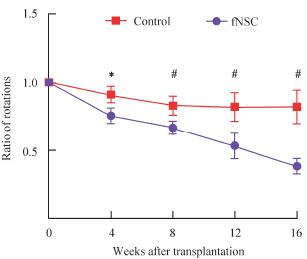
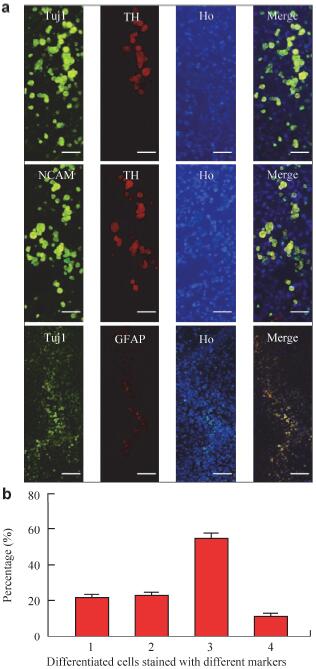
摘要 Objective: Parkinson's disease (PD), which is one of the most common neurodegenerative disorders, is characterized by the loss of dopamine (DA) neurons in the substantia nigra in the midbrain. Experimental and clinical studies have shown that fetal neural stem cells (NSCs) have therapeutic effects in neurological disorders. The aim of this study was to examine whether cells that were differentiated from NSCs had therapeutic effects in a rat model of PD. Methods: NSCs were isolated from 14-week-old embryos and induced to differentiate into neurons, DA neurons, and glial cells, and these cells were characterized by their expression of the following markers:βⅢ-tubulin and microtubule-associated protein 2 (neurons), tyrosine hydroxylase (DA neurons), and glial fibrillary acidic protein (glial cells). After a 6-hydroxydopamine (6-OHDA)-lesioned rat model of PD was generated, the differentiated cells were transplanted into the striata of the 6-OHDAlesioned PD rats. Results: The motor behaviors of the PD rats were assessed by the number of apomorphine-induced rotation turns. The results showed that the NSCs differentiated in vitro into neurons and DA neurons with high efficiencies. After transplantation into the striata of the PD rats, the differentiated cells significantly improved the motor deficits of the transplanted PD rats compared to those of the control nontransplanted PD rats by decreasing the apomorphine-induced turn cycles as early as 4 weeks after transplantation. Immunofluorescence analyses showed that the differentiated DA neurons survived more than 16 weeks. Conclusions: Our results showed that cells that were differentiated from NSCs had therapeutic effects in a rat PD model, which suggests that differentiated cells may be an effective treatment for patients with PD.
Abstract: Objective: Parkinson's disease (PD), which is one of the most common neurodegenerative disorders, is characterized by the loss of dopamine (DA) neurons in the substantia nigra in the midbrain. Experimental and clinical studies have shown that fetal neural stem cells (NSCs) have therapeutic effects in neurological disorders. The aim of this study was to examine whether cells that were differentiated from NSCs had therapeutic effects in a rat model of PD. Methods: NSCs were isolated from 14-week-old embryos and induced to differentiate into neurons, DA neurons, and glial cells, and these cells were characterized by their expression of the following markers:βⅢ-tubulin and microtubule-associated protein 2 (neurons), tyrosine hydroxylase (DA neurons), and glial fibrillary acidic protein (glial cells). After a 6-hydroxydopamine (6-OHDA)-lesioned rat model of PD was generated, the differentiated cells were transplanted into the striata of the 6-OHDAlesioned PD rats. Results: The motor behaviors of the PD rats were assessed by the number of apomorphine-induced rotation turns. The results showed that the NSCs differentiated in vitro into neurons and DA neurons with high efficiencies. After transplantation into the striata of the PD rats, the differentiated cells significantly improved the motor deficits of the transplanted PD rats compared to those of the control nontransplanted PD rats by decreasing the apomorphine-induced turn cycles as early as 4 weeks after transplantation. Immunofluorescence analyses showed that the differentiated DA neurons survived more than 16 weeks. Conclusions: Our results showed that cells that were differentiated from NSCs had therapeutic effects in a rat PD model, which suggests that differentiated cells may be an effective treatment for patients with PD.
Wei Wang, Hao Song, Aifang Shen, Chao Chen, Yanming Liu, Yabing Dong, Fabin Han. Differentiated cells derived from fetal neural stem cells improve motor deficits in a rat model of Parkinson's disease[J]. 临床转化神经科学, 2015, 1(2): 75-85.
Wei Wang, Hao Song, Aifang Shen, Chao Chen, Yanming Liu, Yabing Dong, Fabin Han. Differentiated cells derived from fetal neural stem cells improve motor deficits in a rat model of Parkinson's disease. Translational Neuroscience and Clinics, 2015, 1(2): 75-85.
[1] Bezard E, Dovero S, Prunier C, Ravenscroft P, Chalon S, Guilloteau D, Crossman AR, Bioulac B, Brotchie JM, Gross CE. Relationship between the appearance of symptoms and the level of nigrostriatal degeneration in a progressive 1-methyl-4-phenyl-1, 2, 3, 6-tetrahydropyridinelesioned macaque model of Parkinson's disease. J Neurosci 2001, 21(17):6853-6861.
[2] de Rijk MC, Launer LJ, Berger K, Breteler MMB, Dartigues JF, Baldereschi M, Fratiglioni L, Lobo A, Martinez-Lage J, Trenkwalder C, Hofman A. Prevalence of Parkinson's disease in Europe:A collaborative study of populationbased cohorts. Neurology 2000, 54(11 Suppl 5):S21-S23.
[3] Han FB, Wang W, Chen BX, Chen C, Li S, Lu XJ, Duan J, Zhang Y, Zhang YA, Guo WN, Li GY. Human induced pluripotent stem cell-derived neurons improve motor asymmetry in a 6-hydroxydopamine-induced rat model of Parkinson's disease. Cytotherapy 2015, 17(5):665-679.
[4] Costello S, Cockburn M, Bronstein J, Zhang X, Ritz B. Parkinson's disease and residential exposure to maneb and paraquat from agricultural applications in the central valley of California. Am J Epidemiol 2009, 169(8):919-926.
[5] Ryan BJ, Hoek S, Fon EA, Wade-Martins R. Mitochondrial dysfunction and mitophagy in Parkinson's:From familial to sporadic disease. Trends Biochem Sci 2015, 40(4):200-210.
[6] Savitt JM, Dawson VL, Dawson TM. Diagnosis and treatment of Parkinson disease:Molecules to medicine. J Clin Invest 2006, 116(7):1744-1754.
[7] Aarsland D, Andersen K, Larsen JP, Lolk A, Nielsen H, Kragh-Sørensen P. Risk of dementia in Parkinson's disease:A community-based, prospective study. Neurology 2001, 56(6):730-736.
[8] Lees AJ, Hardy J, Revesz T. Parkinson's disease. Lancet 2009, 373(9680):2055-2066.
[9] Obeso JA, Rodriguez-Oroz MC, Rodriguez M, DeLong MR, Olanow CW. Pathophysiology of levodopa-induced dyskinesias in Parkinson's disease:Problems with the current model. Ann Neurol 2000, 47(4 Suppl 1):S22-S32.
[10] Cheng HC, Ulane CM, Burke RE. Clinical progression in Parkinson disease and the neurobiology of axons. Ann Neurol 2010, 67(6):715-725.
[11] Bergman H, Deuschl G. Pathophysiology of Parkinson's disease:From clinical neurology to basic neuroscience and back. Mov Disord 2002, 17(Suppl 3):S28-S40.
[12] Lee HM, Koh SB. Many faces of Parkinson's disease:Non-motor symptoms of Parkinson's disease. J Mov Disord 2015, 8(2):92-97.
[13] Fahn S, Oakes D, Shoulson I, Kieburtz K, Rudolph A, Lang A, Olanow CW, Tanner C, Marek K. Levodopa and the progression of Parkinson's disease. N Engl J Med 2004, 351(24):2498-2508.
[14] Chaudhuri KR, Healy DG, Schapira AHV. Non-motor symptoms of Parkinson's disease:Diagnosis and management. Lancet Neurol 2006, 5(3):235-245.
[15] Meyer AK, Maisel M, Hermann A, Stirl K, Storch A. Restorative approaches in Parkinson's disease:Which cell type wins the race? J Neurol Sci 2010, 289(1-2):93-103.
[16] Kriks S, Shim JW, Piao J, Ganat YM, Wakeman DR, Xie Z, Carrillo-Reid L, Auyeung G, Antonacci C, Buch A, Yang LC, Beal MF, Surmeier DJ, Kordower JH, Tabar V, Studer L. Dopamine neurons derived from human ES cells efficiently engraft in animal models of Parkinson's disease. Nature 2011, 480(7378):547-551.
[17] Han FB. The applications of the induced pluripotent stem cells in studying the neurodegenerative diseases. Chin J Cell Biol 2012, 34(5):403-414. (in Chinese)
[18] Fricker RA, Carpenter MK, Winkler C, Greco C, Gates MA, Björklund A. Site-specific migration and neuronal differentiation of human neural progenitor cells after transplantation in the adult rat brain. J Neurosci 1999, 19(14):5990-6005.
[19] Nishino H, Hida H, Takei N, Kumazaki M, Nakajima K, Baba H. Mesencephalic neural stem(progenitor) cells develop to dopaminergic neurons more strongly in dopamine-depleted striatum than in intact striatum. Exp Neurol 2000, 164(1):209-214.
[20] Andersson E, Tryggvason U, Deng QL, Friling S, Alekseenko Z, Robert B, Perlmann T, Ericson J. Identification of intrinsic determinants of midbrain dopamine neurons. Cell 2006, 124(2):393-405.
[21] Burbach JPH, Smidt MP. Molecular programming of stem cells into mesodiencephalic dopaminergic neurons. Trends Neurosci 2006, 29(11):601-603.
[22] Kim HJ, McMillan E, Han FB, Svendsen CN. Regionally specified human neural progenitor cells derived from the mesencephalon and forebrain undergo increased neurogenesis following overexpression of ASCL1. Stem Cells 2009, 27(2):390-398.
[23] Gonzalez C, Bonilla S, Flores AI, Cano E, Liste I. An update on human stem cell-based therapy in Parkinson's disease. Curr Stem Cell Res Ther, in press, DOI 10.2174/1574888X10666150531172612.
[24] Papanikolaou T, Lennington JB, Betz A, Figueiredo C, Salamone JD, Conover JC. In vitro generation of dopaminergic neurons from adult subventricular zone neural progenitor cells. Stem Cells Dev 2008, 17(1):157-172.
[25] Freed CR, Breeze RE, Rosenberg NL, Schneck SA, Kriek E, Qi JX, Lone T, Zhang YB, Snyder JA, Wells TH, Ramig LO, Thompson L, Mazziotta JC, Huang SC, Grafton ST, Brooks D, Sawle G, Schroter G, Ansari AA. Survival of implanted fetal dopamine cells and neurologic improvement 12 to 46 months after transplantation for Parkinson's disease. N Engl J Med 1992, 327(22):1549-1555.
[26] Kordower JH, Freeman TB, Snow BJ, Vingerhoets FJ, Mufson EJ, Sanberg PR, Hauser RA, Smith DA, Nauert GM, Perl DP, Olanow CW. Neuropathological evidence of graft survival and striatal reinnervation after the transplantation of fetal mesencephalic tissue in a patient with Parkinson's disease. N Engl J Med 1995, 332(17):1118-1124.
[27] Lindvall O, Sawle G, Widner H, Rothwell JC, Björklund A, Brooks D, Brundin P, Frackowiak R, Marsden CD, Odin P, Rehncrona S. Evidence for long-term survival and function of dopaminergic grafts in progressive Parkinson's disease. Ann Neurol 1994, 35(2):172-180.
[28] Freed CR, Greene PE, Breeze RE, Tsai WY, DuMouchel W, Kao R, Dillon S, Winfield H, Culver S, Trojanowski JQ, Eidelberg D, Fahn S. Transplantation of embryonic dopamine neurons for severe Parkinson's disease. N Engl J Med 2001, 344(10):710-719.
[29] Lindvall O, Brundin P, Widner H, Rehncrona S, Gustavii B, Frackowiak R, Leenders KL, Sawle G, Rothwell JC, Marsden CD, Björklund A. Grafts of fetal dopamine neurons survive and improve motor function in Parkinson's disease. Science 1990, 247(4942):574-577.
[30] Hagell P, Brundin P. Cell survival and clinical outcome following intrastriatal transplantation in Parkinson disease. J Neuropathol Exp Neurol 2001, 60(8):741-752.
[31] Lindvall O, Björklund A. Cell therapy in Parkinson's disease. Neuro Rx 2004, 1(4):382-393.
[32] Barker RA, Barrett J, Mason SL, Björklund A. Fetal dopaminergic transplantation trials and the future of neural grafting in Parkinson's disease. Lancet Neurol 2013, 12(1):84-91.
[33] Svendsen CN, Caldwell MA, Shen J, ter Borg MG, Rosser AE, Tyers P, Karmiol S, Dunnett SB. Long-term survival of human central nervous system progenitor cells transplanted into a rat model of Parkinson's disease. Exp Neurol 1997, 148(1):135-146.
[34] Kallur T, Darsalia V, Lindvall O, Kokaia Z. Human fetal cortical and striatal neural stem cells generate region-specific neurons in vitro and differentiate extensively to neurons after intrastriatal transplantation in neonatal rats. J Neurosci Res 2006, 84(8):1630-1644.
[35] Yan YP, Yang DL, Zarnowska ED, Du ZW, Werbel B, Valliere C, Pearce RA, Thomson JA, Zhang SC. Directed differentiation of dopaminergic neuronal subtypes from human embryonic stem cells. Stem Cells 2005, 23(6):781-790.
[36] Sundberg M, Bogetofte H, Lawson T, Jansson J, Smith G, Astradsson A, Moore M, Osborn T, Cooper O, Spealman R, Hallett P, Isacson O. Improved cell therapy protocols for Parkinson's disease based on differentiation efficiency and safety of hESC-, hiPSC-, and non-human primate iPSCderived dopaminergic neurons. Stem Cells 2013, 31(8):1548-1562.
[37] Lu P, Wang YZ, Graham L, McHale K, Gao MY, Wu D, Brock J, Blesch A, Rosenzweig ES, Havton LA, Zheng BH, Conner JM, Marsala M, Tuszynski MH. Long-distance growth and connectivity of neural stem cells after severe spinal cord injury. Cell 2012, 150(6):1264-1273.
[38] Eriksson PS, Perfilieva E, Björk-Eriksson T, Alborn AM, Nordborg C, Peterson DA, Gage FH. Neurogenesis in the adult human hippocampus. Nat Med 1998, 4(11):1313-1317.
[39] Doetsch F, Caillé I, Lim DA, García-Verdugo JM, Alvarez-Buylla A. Subventricular zone astrocytes are neural stem cells in the adult mammalian brain. Cell 1999, 97(6):703-716.
[40] Taupin P, Gage FH. Adult neurogenesis and neural stem cells of the central nervous system in mammals. J Neurosci Res 2002, 69(6):745-749.
[41] Brundin P, Nilsson OG, Strecker RE, Lindvall O, Åstedt B, Björklund A. Behavioural effects of human fetal dopamine neurons grafted in a rat model of Parkinson's disease. Exp Brain Res 1986, 65(1):235-240.
[42] Studer L, Tabar V, McKay RD. Transplantation of expanded mesencephalic precursors leads to recovery in parkinsonian rats. Nat Neurosci 1998, 1(4):290-295.
[43] Monni E, Cusulin C, Cavallaro M, Lindvall O, Kokaia Z. Human fetal striatum-derived neural stem (NS) cells differentiate to mature neurons in vitro and in vivo. Curr Stem Cell Res Ther 2014, 9(4):338-346.
[44] Chambers SM, Fasano CA, Papapetrou EP, Tomishima M, Sadelain M, Studer L. Highly efficient neural conversion of human ES and iPS cells by dual inhibition of SMAD signaling. NatBiotechnol 2009, 27(3):275-280.
[45] Yang DL, Zhang ZJ, Oldenburg M, Ayala M, Zhang SC. Human embryonic stem cell-derived dopaminergic neurons reverse functional deficit in parkinsonian rats. Stem Cells 2008, 26(1):55-63.
[46] Roy NS, Cleren C, Singh SK, Yang LC, Beal MF, Goldman SA. Functional engraftment of human ES cell-derived dopaminergic neurons enriched by coculture with telomeraseimmortalized midbrain astrocytes. Nat Med 2006, 12(11):1259-1268.
[47] Björklund A, Lindvall O. Cell replacement therapies for central nervous system disorders. Nat Neurosci 2000, 3(6):537-544.
[48] Kang XJ, Xu HD, Teng SS, Zhang XY, Deng ZJ, Zhou L, Zuo PL, Liu B, Wu QH, Wang L, Hu MQ, Dou HQ, Liu W, Zhu FP, Li Q, Guo S, Gu JL, Lei Q, Lv J, Mu Y, Jin M, Wang SR, Jiang W, Liu K, Wang CH, Li WL, Zhang K, Zhou Z. Dopamine release from transplanted neural stem cells in Parkinsonian rat striatum in vivo. Proc Natl Acad Sci USA 2014, 111(44):15804-15809.
 2015, Vol. 1