Effects of voluntary imipramine intake via food and water in paradigms of anxiety and depression in naïve mice
João Pedro Costa-Nunes1,2,3, Anastassia Bakhmet4, Margarida Araújo-Correia3,5, Andreia Barbosa Valença3,6, Tatyana Strekalova1,3, Harry W. M. Steinbusch1
1 School for Mental Health and Neuroscience, Maastricht University, Universiteitssingel 40, Maastricht NL 6229 ER, the Netherlands;
2 Center for Neuroscience and Cell Biology, Universidade de Coimbra, Faculdade de Medicina, Rua Larga, Pólo I, Coimbra 3004-504, Portugal;
3 Centro de Biologia Ambiental, Faculdade de Ciências da Universidade de Lisboa, Edifício C2, Campo Grande, Lisbon 1749-016, Portugal;
4 Department of Human Anatomy, Moscow State Medical University, Moscow 125009, Russia;
5 Centro de Estudos de Doenças Crónicas(CEDOC), Edifício CEDOC II, Rua Câmara Pestana, n°6-6 A, Lisboa, Lisbon 1150-082, Portugal;
6 Centro Interdisciplinar de Investigação em Saúde Animal(CIISA), Faculdade de Medicina Veterinária, Alameda da Universidade Técnica, Lisboa, Lisbon 1300-477, Portugal
Effects of voluntary imipramine intake via food and water in paradigms of anxiety and depression in naïve mice
João Pedro Costa-Nunes1,2,3, Anastassia Bakhmet4, Margarida Araújo-Correia3,5, Andreia Barbosa Valença3,6, Tatyana Strekalova1,3, Harry W. M. Steinbusch1
1 School for Mental Health and Neuroscience, Maastricht University, Universiteitssingel 40, Maastricht NL 6229 ER, the Netherlands;
2 Center for Neuroscience and Cell Biology, Universidade de Coimbra, Faculdade de Medicina, Rua Larga, Pólo I, Coimbra 3004-504, Portugal;
3 Centro de Biologia Ambiental, Faculdade de Ciências da Universidade de Lisboa, Edifício C2, Campo Grande, Lisbon 1749-016, Portugal;
4 Department of Human Anatomy, Moscow State Medical University, Moscow 125009, Russia;
5 Centro de Estudos de Doenças Crónicas(CEDOC), Edifício CEDOC II, Rua Câmara Pestana, n°6-6 A, Lisboa, Lisbon 1150-082, Portugal;
6 Centro Interdisciplinar de Investigação em Saúde Animal(CIISA), Faculdade de Medicina Veterinária, Alameda da Universidade Técnica, Lisboa, Lisbon 1300-477, Portugal
摘要 Objective: We sought to investigate the efficacy of oral dosing in mice with imipramine (7mg/kg/day) via water or in food pellets, and to compare its effects in the paradigms of learned helplessness, locomotion, hedonic state, and anxiety. Methods: Water and food consumption were measured to determine daily imipramine dosage in C57BL/6N mice. Next, baseline scores for O-maze, dark/light box, and sucrose tests were measured. Mice were then subjected to a 4-week treatment of voluntary ingestion of drinking water or food pellets containing imipramine. Lastly, all groups were subjected to novel cage, open field, O-maze, dark/light box, sucrose test, and forced swim test to assess the effects of the treatment. Results: In naïve mice, imipramine delivered via food, induced a reduction of total floating and increased latency in the forced swim test, i.e., antidepressant-like effects. No other significant effects were found. Dosing with water did not change behavior in the forced swim, sucrose preference test, anxiety, or locomotor paradigms, but increased exploration in the novel cage. Conclusions: Voluntary ingestion is an effective method of chronic dosing with imipramine in naïve mice. Delivery of imipramine with food pellets elicits antidepressant-like effects in the forced swim test, with no effects on anxiety, locomotion, or preference behaviors. In contrast, no such effects were observed with treatment via drinking water, suggesting that a higher dose may be required. Our work argues for a broader use of oral delivery using food-treated pellets, in small rodent models of pre-clinical depression. It may substantially improve animal welfare and overcome potential confounds in translational research, which are frequently associated with adverse chronic invasive pharmacotherapies.
Abstract: Objective: We sought to investigate the efficacy of oral dosing in mice with imipramine (7mg/kg/day) via water or in food pellets, and to compare its effects in the paradigms of learned helplessness, locomotion, hedonic state, and anxiety. Methods: Water and food consumption were measured to determine daily imipramine dosage in C57BL/6N mice. Next, baseline scores for O-maze, dark/light box, and sucrose tests were measured. Mice were then subjected to a 4-week treatment of voluntary ingestion of drinking water or food pellets containing imipramine. Lastly, all groups were subjected to novel cage, open field, O-maze, dark/light box, sucrose test, and forced swim test to assess the effects of the treatment. Results: In naïve mice, imipramine delivered via food, induced a reduction of total floating and increased latency in the forced swim test, i.e., antidepressant-like effects. No other significant effects were found. Dosing with water did not change behavior in the forced swim, sucrose preference test, anxiety, or locomotor paradigms, but increased exploration in the novel cage. Conclusions: Voluntary ingestion is an effective method of chronic dosing with imipramine in naïve mice. Delivery of imipramine with food pellets elicits antidepressant-like effects in the forced swim test, with no effects on anxiety, locomotion, or preference behaviors. In contrast, no such effects were observed with treatment via drinking water, suggesting that a higher dose may be required. Our work argues for a broader use of oral delivery using food-treated pellets, in small rodent models of pre-clinical depression. It may substantially improve animal welfare and overcome potential confounds in translational research, which are frequently associated with adverse chronic invasive pharmacotherapies.
通讯作者:
João Pedro Costa-Nunes, E-mail:jp.nunes@cnc.uc.pt
E-mail: jp.nunes@cnc.uc.pt
引用本文:
João Pedro Costa-Nunes, Anastassia Bakhmet, Margarida Araújo-Correia, Andreia Barbosa Valença, Tatyana Strekalova, Harry W. M. Steinbusch. Effects of voluntary imipramine intake via food and water in paradigms of anxiety and depression in naïve mice[J]. 临床转化神经科学, 2016, 2(3): 172-182.
João Pedro Costa-Nunes, Anastassia Bakhmet, Margarida Araújo-Correia, Andreia Barbosa Valença, Tatyana Strekalova, Harry W. M. Steinbusch. Effects of voluntary imipramine intake via food and water in paradigms of anxiety and depression in naïve mice. Translational Neuroscience and Clinics, 2016, 2(3): 172-182.
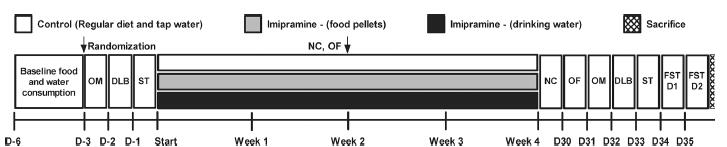
20161117200058 Figure 1 Study flow. Time is expressed in days, relative to treatment period (D). Behavioral tests: OM—O-maze; DLB—Dark/light box; ST—Sucrose test; NC—Novel cage; OF—Open field; FST—Forced swim test. Number of animals: Control, n = 7; Imipramine (food), n = 8; Imipramine (water), n = 8.
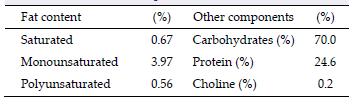
20161117200126 Table 1 Nutritional composition of standard diet
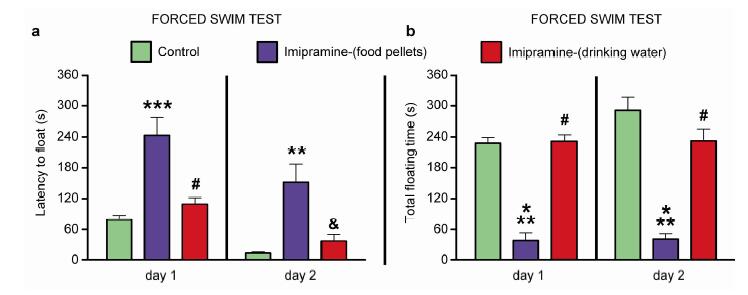
20161117200326 Figure 2 Antidepressant-like effects of imipramine in the forced swim test. In comparison with control group and animals treated with imipramine in drinking water, mice that received imipramine in food pellets exhibit increased latency to float (a) and reduced total duration of floating (b). *P < 0.05 vs control; **P < 0.01 vs control; ***P < 0.001 vs control; &P < 0.01 vs. imi-food or imi-drink; #P < 0.001 vs imi-food or imi-drink; aP < 0.05 vs baseline. Data are represented as mean ± standard error of mean (SEM). Number of animals: Control, n = 7; Imipramine (food), n = 8; Imipramine (water), n = 8.
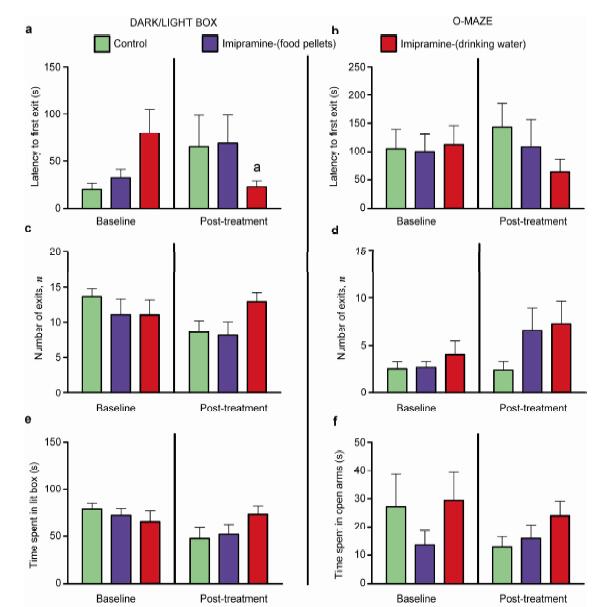
20161117200501 Figure 3 Effects of imipramine on anxiety-like behaviour. No significant differences were found in latency (a, b), number of exits (c, d), or time spent in exposed area (e, f) in both dark/light box and O-maze, respectively. aP < 0.05 vs same group, t test. Data are represented as mean ± standard error of mean (SEM). Number of animals: Control, n = 7; Imipramine (food), n = 8; Imipramine (water), n = 8.
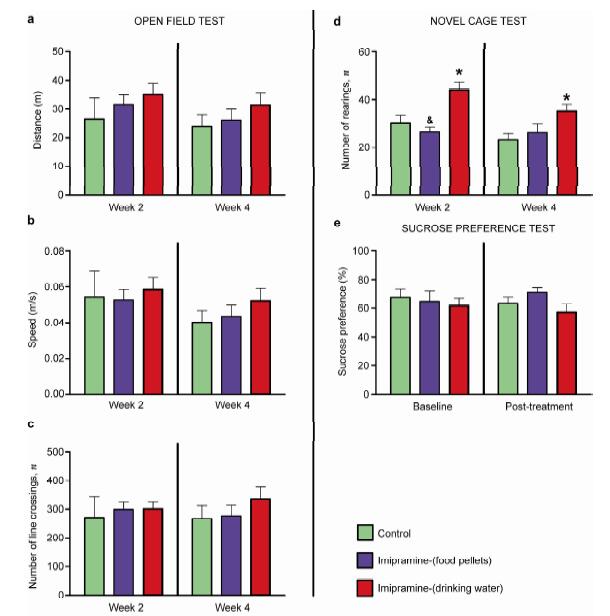
20161117200618 Figure 4 Effects of imipramine on basal parameters of locomotor activity. In the open field test, no differences were found in distance travelled (a), average speed of locomotion (b), or number of line crossings (c) between groups. Increased number of rearings is found in the novel cage test for animals receiving treatment in water, when compared to a control group (d). Sucrose preference is not different between control and imipramine-treated groups (e). Data are represented as mean ± standard error of mean (SEM). Number of animals: Control, n = 7; Imipramine (food), n = 8; Imipramine (water), n = 8.
[1] Munos B. Lessons from 60 years of pharmaceutical innova-tion. Nat Rev Drug Discov 2009, 8(12):959-968.
[2] Pigott HE, Leventhal AM, Alter GS, Boren JJ. Efficacy and effectiveness of antidepressants:Current status of research.Psychother Psychosom 2010, 79(5):267-279.
[3] Araragi N, Lesch KP. Serotonin (5-HT) in the regulation of depression-related emotionality:Insight from 5-HT transporter and tryptophan hydroxylase-2 knockout mouse models. Curr Drug Targets 2013, 14(5):549-570.
[4] Insel TR. From animal models to model animals. Biol Psychiatry 2007, 62(12):1337-1339.
[5] Insel TR, Sahakian BJ, Voon V, Nye J, Brown VJ, Altevogt BM, Bullmore ET, Goodwin GM, Howard RJ, Kupfer DJ, et al. Drug research:A plan for mental illness. Nature 2012, 483(7389):269.
[6] Strekalova T, Anthony DC, Dolgov O, Anokhin K, Kubatiev A, Steinbusch HMW, Schroeter C. The differential effects of chronic imipramine or citalopram administration on physiological and behavioral outcomes in naïve mice. Behav Brain Res 2013, 245:101-106.
[7] Costa-Nunes JP, Cline BH, Araújo-Correia M, Valença A, Markova N, Dolgov O, Kubatiev A, Yeritsyan N, Steinbusch HW, Strekalova T. Animal models of depression and drug delivery with food as an effective dosing method:Evidences from studies with Celecoxib and Dicholine succinate. Biomed Res Int 2015, 2015:596126.
[8] Strekalova TV, Cespuglio R, Koval'zon VM. Depressive-like state and sleep in laboratory mice. Zh Vyssh Nerv Deiat Im I P Pavlova 2008, 58(6):728-737.
[9] Strekalova T, Couch Y, Kholod N, Boyks M, Malin D, Leprince P, Steinbusch HMW. Update in the methodology of the chronic stress paradigm:Internal control matters. Behav Brain Funct 2011, 7:9.
[10] Strekalova T, Steinbusch H. Factors of reproducibility of anhedonia induction in a chronic stress depression model in mice. In:Mood and Anxiety Related Phenotypes in Mice:Characterization Using Behavioral Tests. Gould TD, Ed. New Jersey:Humana Press, 2009, pp 153-176.
[11] Strekalova T, Steinbusch HWM. Measuring behavior in mice with chronic stress depression paradigm. Prog Neuropsychopharmacol Biol Psychiatry 2010, 34(2):348-361.
[12] Sato Y, Seo N, Kobahashi E. The dosing-time dependent effects of intravenous hypnotics in mice. Anesth Analg 2005, 101(6):1706-1708.
[13] Munn E, Bunning M, Prada S, Bohlen M, Crabbe JC, Wahlsten D. Reversed light-dark cycle and cage enrichment effects on ethanol-induced deficits in motor coordination assessed in inbred mouse strains with a compact battery of refined tests. Behav Brain Res 2011, 224(2):259-271.
[14] Strekalova T, Spanagel R, Dolgov O, Bartsch D. Stress-induced hyperlocomotion as a confounding factor in anxiety and depression models in mice. Behav Pharmacol 2005, 16(3):171-180.
[15] Ringgold KM, Barf RP, George A, Sutton BC, Opp MR. Prolonged sleep fragmentation of mice exacerbates febrile responses to lipopolysaccharide. J Neurosci Methods 2013, 219(1):104-112.
[16] Cloutier S, Wahl K, Baker C, Newberry RC. The social buffering effect of playful handling on responses to repeated intraperitoneal injections in laboratory rats. J Am Assoc Lab Anim Sci 2014, 53(2):168-173.
[17] Bohlen M, Hayes ER, Bohlen B, Bailoo JD, Crabbe JC, Wahlsten D. Experimenter effects on behavioral test scores of eight inbred mouse strains under the influence of ethanol. Behav Brain Res 2014, 272:46-54.
[18] Sorge RE, Martin LJ, Isbester KA, Sotocinal SG, Rosen S, Tuttle AH, Wieskopf JS, Acland EL, Dokova A, Kadoura B, et al. Olfactory exposure to males, including men, causes stress and related analgesia in rodents. Nat Methods 2014, 11(6):629-632.
[19] Sousa N, Almeida OF, Wotjak CT. A hitchhiker's guide to behavioral analysis in laboratory rodents. Genes Brain Behav 2006, 5 Suppl 2:5-24.
[20] Azar TA, Sharp JL, Lawson DM. Heart rates of male and female Sprague-Dawley and spontaneously hypertensive rats housed singly or in groups. J Am Assoc Lab Anim Sci 2011, 50(2):175-184.
[21] Gärtner K, Büttner D, Döhler K, Friedel R, Lindena J, Trautschold I. Stress response of rats to handling and experimental procedures. Lab Anim 1980, 14(3):267-274.
[22] Cloutier S, Newberry RC. Use of a conditioning technique to reduce stress associated with repeated intra-peritoneal injections in laboratory rats. Appl Anim Behav Sci 2008, 112(1-2):158-173.
[23] Thiele TE, Navarro M. "Drinking in the dark" (DID) procedures:A model of binge-like ethanol drinking in non-dependent mice. Alcohol 2014, 48(3):235-241.
[24] Machado-Vieira R, Baumann J, Wheeler-Castillo C, Latov D, Henter ID, Salvadore G, Zarate CA Jr. The timing of antidepressant effects:A comparison of diverse phar-macological and somatic treatments. Pharmaceuticals (Basel) 2010, 3(1):19-41.
[25] Yan HC, Cao X, Das M, Zhu XH, Gao TM. Behavioral animal models of depression. Neurosci Bull 2010, 26(4):327-337.
[26] Krishnan V, Nestler EJ. Animal models of depression:Molecular perspectives. In:Molecular and Functional Models in Neuropsychiatry. Hagan JJ, Ed. Berlin Heidelberg:Springer, 2011, pp 121-147.
[27] Steru L, Chermat R, Thierry B, Simon P. The tail suspension test:A new method for screening antidepressants in mice. Psychopharmacology (Berl) 1985, 85(3):367-370.
[28] Steru L, Chermat R, Thierry B, Mico JA, Lenegre A, Steru M, Simon P, Porsolt RD. The automated Tail Suspension Test:A computerized device which differentiates psychotropic drugs. Prog Neuropsychopharmacol Biol Psychiatry 1987, 11(6):659-671.
[29] Teste JF, Pelsy-Johann I, Decelle T, Boulu RG. Anti-immobility activity of different antidepressant drugs using the tail suspension test in normal or reserpinized mice. Fundam Clin Pharmacol 1993, 7(5):219-226.
[30] Bai FJ, Li X, Clay M, Lindstrom T, Skolnick P. Intra-and interstrain differences in models of "behavioral despair". Pharmacol Biochem Behav 2001, 70(2-3):187-192.
[31] Castagné V, Porsolt RD, Moser P. Early behavioral screening for antidepressants and anxiolytics. Drug Dev Res 2006, 67(9):729-742.
[32] Castagné V, Porsolt RD, Moser P. Use of latency to immobility improves detection of antidepressant-like activity in the behavioral despair test in the mouse. Eur J Pharmacol 2009, 616(1-3):128-133.
[33] O'Neill MF, Fernández AG, Palacios JM. GR 127935 blocks the locomotor and antidepressant-like effects of RU 24969 and the action of antidepressants in the mouse tail suspension test. Pharmacol Biochem Behav 1996, 53(3):535-539.
[34] Azima H. Imipramine (Tofranil):A new drug for the depressed. Can Med Assoc J 1959, 80(7):535-540.
[35] Grecksch G, Zhou D, Franke C, Schröder U, Sabel B, Becker A, Huether G. Influence of olfactory bulbectomy and subsequent imipramine treatment on 5-hydroxytryptaminergic presynapses in the rat frontal cortex:Behavioural correlates. Br J Pharmacol 1997, 122(8):1725-1731.
[36] Winterhoff H, Spengler B, Christoffel V, Butterweck V, Löhning A. Cimicifuga extract BNO 1055:Reduction of hot flushes and hints on antidepressant activity. Maturitas 2003, 44 Suppl 1:S51-S58.
[37] Kaminsky BM, Bostwick JR, Guthrie SK. Alternate routes of administration of antidepressant and antipsychotic medications. Ann Pharmacother 2015, 49(7):808-817.
[38] Cline BH, Anthony DC, Lysko A, Dolgov O, Anokhin K, Schroeter C, Malin D, Kubatiev A, Steinbusch HW, Lesch KP, et al. Lasting downregulation of the lipid peroxidation enzymes in the prefrontal cortex of mice susceptible to stress-induced anhedonia. Behav Brain Res 2015, 276:118-129.<
 2016, Vol. 2