Differences in the prognostic value of tumor extent of resection among the molecular subgroups of medulloblastoma:A single centre study of 113 cases
Yuyuan Wang1, Kay Kawai Li2, Ji Xiong3, Zhenyu Zhang4, Yang Wang5, Jian Xu1, Yin Wang3, Hokeung Ng2, Ping Zhong1
1 Department of Neurosurgery, Huashan Hospital, Fudan University, Shanghai 200040, China;
2 Department of Anatomical and Cellular Pathology, Prince of Wales Hospital, the Chinese University of Hong Kong, Hong Kong 999077, China;
3 Department of Pathology, Huashan Hospital, Fudan University, Shanghai 200040, China;
4 Department of Neurosurgery, the First Affiliated Hospital of Zhengzhou University, Zhengzhou University, Zhengzhou 450052, China;
5 Department of Radiotherapy, Huashan Hospital, Fudan University, Shanghai 200040, China
Differences in the prognostic value of tumor extent of resection among the molecular subgroups of medulloblastoma:A single centre study of 113 cases
Yuyuan Wang1, Kay Kawai Li2, Ji Xiong3, Zhenyu Zhang4, Yang Wang5, Jian Xu1, Yin Wang3, Hokeung Ng2, Ping Zhong1
1 Department of Neurosurgery, Huashan Hospital, Fudan University, Shanghai 200040, China;
2 Department of Anatomical and Cellular Pathology, Prince of Wales Hospital, the Chinese University of Hong Kong, Hong Kong 999077, China;
3 Department of Pathology, Huashan Hospital, Fudan University, Shanghai 200040, China;
4 Department of Neurosurgery, the First Affiliated Hospital of Zhengzhou University, Zhengzhou University, Zhengzhou 450052, China;
5 Department of Radiotherapy, Huashan Hospital, Fudan University, Shanghai 200040, China
摘要 Medulloblastoma (MB) is one of the most common pediatrics malignant tumors of the central nervous system.Studies in America and Europe have demonstrated significant differences in the prognostic value of medulloblastoma extent among molecular subgroups of medulloblastoma.However,studies focusing on the Chinese population are still lacking.A total of 113 patients with medulloblastoma who underwent surgical resection in Huashan Hospital between January 2002 and December 2013 were included in this study.Histological diagnoses were confirmed by 2 or more pathologists.Immunohistochemistry and CTNNB1 exon 3 mutation analysis were used to determine the different subgroups.Complete or incomplete resection was defined based on surgeons' reports and confirmed by postoperative computer tomography (CT).In this study,we included 113 patients with medulloblastoma (13 with WNT subgroup,18 with SHH subgroup,and 82 with non-SHH/WNT subgroups) to assess their event-free and overall survival.We identified event-free survival and overall survival benefit for complete resection over incomplete resection.We found that for patients with NON-SHH/WNT medulloblastoma,incomplete resection was significantly associated with progression and overall survival compared with complete resection.To our best knowledge,the present study is the first to demonstrate the prognostic value of tumor extent of resection among the molecular subgroups of 113 medulloblastoma in the Chinese population.The prognostic benefit of the increased extent of resection for patients with medulloblastoma is attenuated after the molecular subgroups are taken into account.We still need further study to assess the benefit of surgical resection of small residual portions.
Abstract: Medulloblastoma (MB) is one of the most common pediatrics malignant tumors of the central nervous system.Studies in America and Europe have demonstrated significant differences in the prognostic value of medulloblastoma extent among molecular subgroups of medulloblastoma.However,studies focusing on the Chinese population are still lacking.A total of 113 patients with medulloblastoma who underwent surgical resection in Huashan Hospital between January 2002 and December 2013 were included in this study.Histological diagnoses were confirmed by 2 or more pathologists.Immunohistochemistry and CTNNB1 exon 3 mutation analysis were used to determine the different subgroups.Complete or incomplete resection was defined based on surgeons' reports and confirmed by postoperative computer tomography (CT).In this study,we included 113 patients with medulloblastoma (13 with WNT subgroup,18 with SHH subgroup,and 82 with non-SHH/WNT subgroups) to assess their event-free and overall survival.We identified event-free survival and overall survival benefit for complete resection over incomplete resection.We found that for patients with NON-SHH/WNT medulloblastoma,incomplete resection was significantly associated with progression and overall survival compared with complete resection.To our best knowledge,the present study is the first to demonstrate the prognostic value of tumor extent of resection among the molecular subgroups of 113 medulloblastoma in the Chinese population.The prognostic benefit of the increased extent of resection for patients with medulloblastoma is attenuated after the molecular subgroups are taken into account.We still need further study to assess the benefit of surgical resection of small residual portions.
Yuyuan Wang, Kay Kawai Li, Ji Xiong, Zhenyu Zhang, Yang Wang, Jian Xu, Yin Wang, Hokeung Ng, Ping Zhong. Differences in the prognostic value of tumor extent of resection among the molecular subgroups of medulloblastoma:A single centre study of 113 cases[J]. 临床转化神经科学, 2017, 3(2): 66-73.
Yuyuan Wang, Kay Kawai Li, Ji Xiong, Zhenyu Zhang, Yang Wang, Jian Xu, Yin Wang, Hokeung Ng, Ping Zhong. Differences in the prognostic value of tumor extent of resection among the molecular subgroups of medulloblastoma:A single centre study of 113 cases. Translational Neuroscience and Clinics, 2017, 3(2): 66-73.
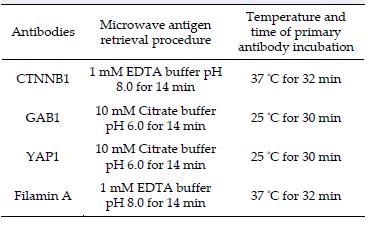
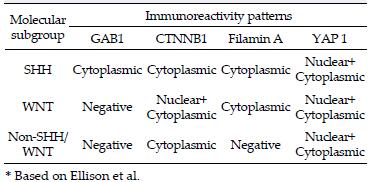
20170712151548 Table 2 Immunoreactivity patterns of SHH, WNT, and Non-SHH/WNT molecular subgroups*.
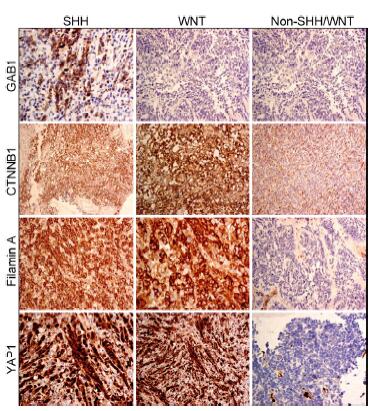
20170712151559 Figure 1 IHC staining of medulloblastoma FFPE. GAB1, CTNNB1, Filamin A, and YAP1 antibodies were used to determine the different subgroups. IHC: Immunohistochemistry; FFPE: formalinfixed paraffin embedded.
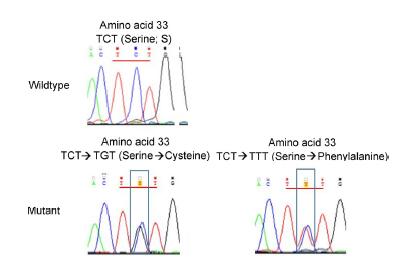
20170712151610 Figure 2 Sequencing performed to confirm the mutation exon 3 of CTNNB1 in FFPE slides. FFPE: formalin-fixed paraffin embedded.
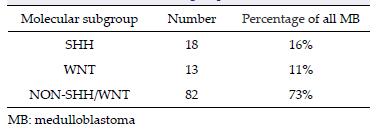
20170712151619 Table 3 Case number and percentage of SHH, WNT, and Non-SHH/WNT molecular subgroups.
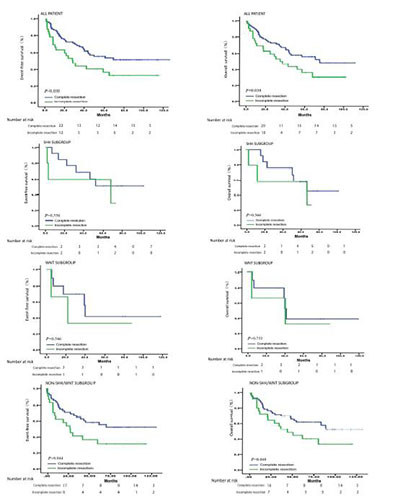
20170712151631 Figure 3 The overall and event-free survival for extent of resection by subgroup. The molecular subgroups are WNT, SHH, and NON-SHH\WNT. Numbers in the parentheses are failure events during that time period. P values are based on the log-rank test across the two strata (Complete resection vs. Incomplete resection).
[1]
Gottardo NG, Hansford JR, McGlade JP, Alvaro F, Ashley DM, Bailey S, Baker DL, Bourdeaut F, Cho YJ, Clay M, Clifford SC, Cohn RJ, Cole CH, Dallas PB, Downie P, Doz F, Ellison DW, Endersby R, Fisher PG, Hassall T, Heath JA, Hii HL, Jones DT, Junckerstorff R, Kellie S, Kool M, Kotecha RS, Lichter P, Laughton SJ, Lee S, McCowage G, Northcott PA, Olson JM, Packer RJ, Pfister SM, Pietsch T, Pizer B, Pomeroy SL, Remke M, Robinson GW, Rutkowski S, Schoep T, Shelat AA, Stewart CF, Sullivan M, Taylor MD, Wainwright B, Walwyn T, Weiss WA, Williamson D, Gajjar A. Medulloblastoma Down Under 2013:A report from the third annual meeting of the International Medulloblastoma Working Group. Acta Neuropathol 2014, 127(2):189-201.
[2]
Dubuc AM, Morrissy AS, Kloosterhof NK, Northcott PA, Yu EP, Shih D, Peacock J, Grajkowska W, van Meter T, Eberhart CG, Pfister S, Marra MA, Weiss WA, Scherer SW, Rutka JT, French PJ, Taylor MD. Subgroup-specific alternative splicing in medulloblastoma. Acta Neuropathol 2012, 123(4):485-499.
[3]
Ramaswamy V, Remke M, Bouffet E, Faria CC, Perreault S, Cho YJ, Shih DJ, Luu B, Dubuc AM, Northcott PA, Schüller U, Gururangan S, McLendon R, Bigner D, Fouladi M, Ligon KL, Pomeroy SL, Dunn S, Triscott J, Jabado N, Fontebasso A, Jones DT, Kool M, Karajannis MA, Gardner SL, Zagzag D, Nunes S, Pimentel J, Mora J, Lipp E, Walter AW, Ryzhova M, Zheludkova O, Kumirova E, Alshami J, Croul SE, Rutka JT, Hawkins C, Tabori U, Codispoti KE, Packer RJ, Pfister SM, Korshunov A, Taylor MD. Recurrence patterns across medulloblastoma subgroups:An integrated clinical and molecular analysis. Lancet Oncol 2013, 14(12):1200-1207.
[4]
Schroeder K, Gururangan S. Molecular variants and mutations in medulloblastoma. Pharmgenomics Pers Med 2014, 7:43-51.
[5]
Gerber NU, Mynarek M, von Hoff K, Friedrich C, Resch A, Rutkowski S. Recent developments and current concepts in medulloblastoma. Cancer Treat Rev 2014, 40(3):356-365.
[6]
Hooper CM, Hawes SM, Kees UR. Gene analyses of the spatio-temporal relationships of human medulloblastoma subgroups during early human neurogenesis. PLoS One 2014, 9(11):e112909.
[7]
Robinson G, Parker M, Kranenburg TA, Lu C, Chen X, Ding L, Phoenix TN, Hedlund E, Wei L, Zhu X, Chalhoub N, Baker SJ, Huether R, Kriwacki R, Curley N, Thiruvenkatam R, Wang J, Wu G, Rusch M, Hong X, Becksfort J, Gupta P, Ma J, Easton J, Vadodaria B, Onar-Thomas A, Lin T, Li S, Pounds S, Paugh S, Zhao D, Kawauchi D, Roussel MF, Finkelstein D, Ellison DW, Lau CC, Bouffet E, Hassall T, Gururangan S, Cohn R, Fulton RS, Fulton LL, Dooling DJ, Ochoa K, Gajjar A, Mardis ER, Wilson RK, Downing JR, Zhang J, Gilbertson RJ. Novel mutations target distinct subgroups of medulloblastoma. Nature 2012, 488(7409):43-48.
[8]
Paul A Northcott, David JH Shih, John Peacock, Livia Garzia, Sorana Morrissy, Thomas Zichner, Adrian M Stütz, Andrey Korshunov. Juri Reimand, Steven E Schumacher, Rameen Beroukhim, David W Ellison, Christian R Marshall, Anath C Lionel, Stephen Mack, Adrian Dubuc, Yuan Yao, Vijay Ramaswamy, Betty Luu, Adi Rolider, Florence Cavalli, Xin Wang, Marc Remke, Xiaochong Wu, Readman YB Chiu, Andy Chu, Eric Chuah, Richard D Corbett, Gemma R Hoad, Shaun D Jackman, Yisu Li, Allan Lo, Karen L Mungall, Ka Ming Nip, Jenny Q Qian, Anthony GJ Raymond, Nina Thiessen, Richard J Varhol, Inanc Birol, Richard A Moore, Andrew J Mungall, Robert Holt, Daisuke Kawauchi, Martine F Roussel, Marcel Kool, David TW Jones, Hendrick Witt, Africa Fernandez-L, Anna M Kenney, Robert J WechslerReya, Peter Dirks, Tzvi Aviv, Wieslawa A Grajkowska, Marta Perek-Polnik, Christine C Haberler, Olivier Delattre, Stéphanie S Reynaud, François F Doz, Sarah S Pernet-Fattet, Byung-Kyu Cho, Seung-Ki Kim, Kyu-Chang Wang, Wolfram Scheurlen, Charles G Eberhart, Michelle Fèvre-Montange, Anne Jouvet, Ian F Pollack, Xing Fan, Karin M Muraszko, G. Yancey Gillespie, Concezio Di Rocco, Luca Massimi, Erna MC Michiels, Nanne K Kloosterhof, Pim J French, Johan M Kros, James M Olson, Richard G Ellenbogen, Karel Zitterbart, Leos Kren, Reid C Thompson, Michael K Cooper, Boleslaw Lach, Roger E McLendon, Darell D Bigner, Adam Fontebasso, Steffen Albrecht, Nada Jabado, Janet C Lindsey, Simon Bailey, Nalin Gupta, William A Weiss, László Bognár, Almos Klekner, Timothy E Van Meter, Toshihiro Kumabe, Teiji Tominaga, Samer K Elbabaa, Jeffrey R Leonard, Joshua B Rubin, Linda M Liau, Erwin G Van Meir, Maryam Fouladi, Hideo Nakamura, Giuseppe Cinalli, Miklós Garami, Peter Hauser, Ali G Saad, Achille Iolascon, Shin Jung, Carlos G Carlotti, Rajeev Vibhakar, Young Shin Ra, Shenandoah Robinson, Massimo Zollo, Claudia C Faria, Jennifer A Chan, Michael L Levy, Poul HB Sorensen, Matthew Meyerson, Scott L Pomeroy, Yoon-Jae Cho, Gary D Bader, Uri Tabori, Cynthia E Hawkins, Eric Bouffet, Stephen W Scherer, James T Rutka, David Malkin, Steven C Clifford, Steven JM Jones, Jan O Korbel, Stefan M Pfister, Marco A Marra, and Michael D Taylor. Subgroupspecific structural variation across 1,000 medulloblastoma genomes. Nature 2012, 488(7409):49-56.
[9]
Peikai Chen, Yubo Fan, Tsz-kwong Man, YS Hung, Ching C Lau, Stephen TC Wong. A gene signature based method for identifying subtypes and subtype-specific drivers in cancer with an application to medulloblastoma. Bmc Bioinformatics, 2013, 14(18):1-13.
[10]
Li KK, Lau KM, Ng HK. Signaling pathway and molecular subgroups of medulloblastoma. Int J Clin Exp Pathol 2013, 6(7):1211-1222.
[11]
Northcott PA, Korshunov A, Witt H, Hielscher T, Eberhart CG, Mack S, Bouffet E, Clifford SC, Hawkins CE, French P, Rutka JT, Pfister S, Taylor MD. Medulloblastoma comprises four distinct molecular variants. J Clin Oncol 2011, 29(11):1408-1414.
[12]
Wefers AK, Warmuth-Metz M, Pöschl J, von Bueren AO, Monoranu CM, Seelos K, Peraud A, Tonn JC, Koch A, Pietsch T, Herold-Mende C, Mawrin C, Schouten-van Meeteren A, van Vuurden D, von Hoff K, Rutkowski S, Pfister SM, Kool M, Schüller U. Subgroup-specific localization of human medulloblastoma based on pre-operative MRI. Acta Neuropathol 2014, 127(6):931-933.
[13]
Ramaswamy V, Remke M, Bouffet E, Faria CC, Perreault S, Cho YJ, Shih DJ, Luu B, Dubuc AM, Northcott PA, Schüller U, Gururangan S, McLendon R, Bigner D, Fouladi M, Ligon KL, Pomeroy SL, Dunn S, Triscott J, Jabado N, Fontebasso A, Jones DT, Kool M, Karajannis MA, Gardner SL, Zagzag D, Nunes S, Pimentel J, Mora J, Lipp E, Walter AW, Ryzhova M, Zheludkova O, Kumirova E, Alshami J, Croul SE, Rutka JT, Hawkins C, Tabori U, Codispoti KE, Packer RJ, Pfister SM, Korshunov A, Taylor MD. Recurrence patterns across medulloblastoma subgroups:An integrated clinical and molecular analysis. Lancet Oncol 2013, 14(12):1200-1207.
[14]
Ellison DW, Dalton J, Kocak M, Nicholson SL, Fraga C, Neale G, Kenney AM, Brat DJ, Perry A, Yong WH, Taylor RE, Bailey S, Clifford SC, Gilbertson RJ. Medulloblastoma:clinicopathological correlates of SHH, WNT, and non-SHH/WNT molecular subgroups. Acta Neuropathol 2011, 121(3):381-396.
[15]
Thompson E M, Hielscher T, Bouffet E, Michael D Taylor. Prognostic value of medulloblastoma extent of resection after accounting for molecular subgroup:A retrospective integrated clinical and molecular analysis. Lancet Oncology, 2016, 17(4):484-495.
[16]
Perreault S, Ramaswamy V, Achrol AS, Chao K, Liu TT, Shih D, Remke M, Schubert S, Bouffet E, Fisher PG, Partap S, Vogel H, Taylor MD, Cho YJ, Yeom KW. MRI surrogates for molecular subgroups of medulloblastoma. AJNR Am J Neuroradiol 2014, 35(7):1263-1269.
[17]
Fattet S, Haberler C, Legoix P, Varlet P, Lellouch-Tubiana A, Lair S, Manie E, Raquin MA, Bours D, Carpentier S, Barillot E, Grill J, Doz F, Puget S, Janoueix-Lerosey I, Delattre O. Beta-catenin status in paediatric medulloblastomas:Correlation of immunohistochemical with mutational status, genetic profiles, and clinical characteristics. Journal of Pathology, 2009, 218(1):86-94.
[18]
Min HS, Lee JY, Kim SK, Park SH. Genetic grouping of medulloblastomas by representative markers in pathologic diagnosis. Transl Oncol. 2013, 6(3):265-272.
[19]
Goschzik T, Zur Mühlen A, Kristiansen G, Haberler C, Stefanits H, Friedrich C, von Hoff K, Rutkowski S, Pfister SM, Pietsch T. Molecular stratification of medulloblastoma:Comparison of histological and genetic methods to detect Wnt activated tumours. Neuropathol Appl Neurobiol. 2015, 41(2):135-144.
[20]
Ramaswamy V, Remke M, Shih D, Wang X, Northcott PA, Faria CC, Raybaud C, Tabori U, Hawkins C, Rutka J, Taylor MD, Bouffet E. Duration of the pre-diagnostic interval in medulloblastoma is subgroup dependent. Pediatric Blood Cancer 2014, 61(7):1190-1194.
[21]
Perreault S, Ramaswamy V, Achrol AS, Chao K, Liu TT, Shih D, Remke M, Schubert S, Bouffet E, Fisher PG, Partap S, Vogel H, Taylor MD, Cho YJ, Yeom KW. MRI surrogates for molecular subgroups of medulloblastoma. Ajnr American Journal of Neuroradiology, 2014, 35(7):1263.
[22]
Schroeder K, Gururangan S. Molecular variants and mutations in medulloblastoma. Pharmgenomics Pers Med 2014, 7:43-51.
[23]
Bien-Willner GA, Lopez-Terrada D, Bhattacharjee MB, Patel KU, Stankiewicz P, Lupski JR, Pfeifer JD, Perry A. Early recurrence in standard-risk medulloblastoma patients with the common idic(17)(p11.2) rearrangement. Neuro Oncol 14:831-840.
 2017, Vol. 3