1 Department of Neurosurgery, Tsinghua University Yuquan Hospital, Beijing 100040, China;
2 Department of Neurology, Tsinghua University Yuquan Hospital, Beijing 100040, China;
3 Shiseido Research Center, Shin-Yokohama 224-8558, Japan;
4 NEWCAT Research Institute, Nihon University College of Engineering, Fukushima 963-8642, Japan
Effects of aging on working memory performance and prefrontal cortex activity: A time-resolved spectroscopy study
1 Department of Neurosurgery, Tsinghua University Yuquan Hospital, Beijing 100040, China;
2 Department of Neurology, Tsinghua University Yuquan Hospital, Beijing 100040, China;
3 Shiseido Research Center, Shin-Yokohama 224-8558, Japan;
4 NEWCAT Research Institute, Nihon University College of Engineering, Fukushima 963-8642, Japan
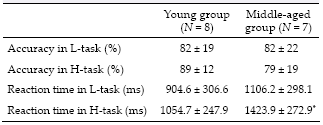
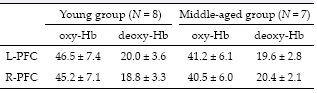
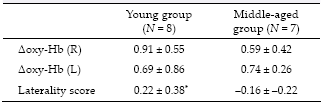
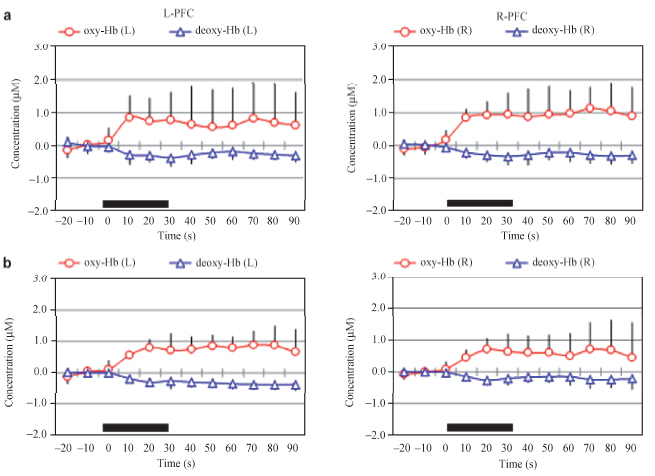
摘要 Objective: This study aimed to employ time-resolved spectroscopy (TRS) to explore age-related differences in prefrontal cortex (PFC) activity while subjects performed a working memory task. Methods: We employed TRS to measure PFC activity in ten healthy younger and ten healthy older subjects while they performed a working memory (WM) task. All subjects performed the Sternberg test (ST) in which the memory-set size varied between one and six digits. Using TRS, we recorded changes in cerebral blood oxygenation as a measure of changes in PFC activity during the task. In order to identify left/right asymmetry of PFC activity during the working memory task, we calculated the laterality score, i.e., Δoxy-Hb (right Δoxy-Hb—left Δoxy-Hb); positive values indicate greater activity in the right PFC, while negative values indicate greater activity in the left PFC. Results: During the ST, statistical analyses showed no significant differences between the younger and older groups in accuracy for low memory-load and high memoryload. In high memory-load tasks, however, older subjects were slower than younger subjects (P < 0.05). We found that the younger group showed right lateral responses with a stronger right than left activation in the frontal pole, whereas the older group showed bilateral responses (P < 0.05). Conclusions: The present results are consistent with the hemispheric asymmetry reduction in older adults (HAROLD) model; working memory tasks cause asymmetrical PFC activation in younger adults, while older adults tend to show reduced hemispheric lateralization.
Abstract: Objective: This study aimed to employ time-resolved spectroscopy (TRS) to explore age-related differences in prefrontal cortex (PFC) activity while subjects performed a working memory task. Methods: We employed TRS to measure PFC activity in ten healthy younger and ten healthy older subjects while they performed a working memory (WM) task. All subjects performed the Sternberg test (ST) in which the memory-set size varied between one and six digits. Using TRS, we recorded changes in cerebral blood oxygenation as a measure of changes in PFC activity during the task. In order to identify left/right asymmetry of PFC activity during the working memory task, we calculated the laterality score, i.e., Δoxy-Hb (right Δoxy-Hb—left Δoxy-Hb); positive values indicate greater activity in the right PFC, while negative values indicate greater activity in the left PFC. Results: During the ST, statistical analyses showed no significant differences between the younger and older groups in accuracy for low memory-load and high memoryload. In high memory-load tasks, however, older subjects were slower than younger subjects (P < 0.05). We found that the younger group showed right lateral responses with a stronger right than left activation in the frontal pole, whereas the older group showed bilateral responses (P < 0.05). Conclusions: The present results are consistent with the hemispheric asymmetry reduction in older adults (HAROLD) model; working memory tasks cause asymmetrical PFC activation in younger adults, while older adults tend to show reduced hemispheric lateralization.
Jie Shi, Wenjing Zhou, Tongchao Geng, Huancong Zuo, Masahiro Tanida, Kaoru Sakatani. Effects of aging on working memory performance and prefrontal cortex activity: A time-resolved spectroscopy study[J]. 临床转化神经科学, 2016, 2(1): 3-7.
Jie Shi, Wenjing Zhou, Tongchao Geng, Huancong Zuo, Masahiro Tanida, Kaoru Sakatani. Effects of aging on working memory performance and prefrontal cortex activity: A time-resolved spectroscopy study. Translational Neuroscience and Clinics, 2016, 2(1): 3-7.
[1] Cabeza R. Hemispheric asymmetry reduction in older adults: The HAROLD model. Psychol Aging 2002, 17(1): 85-100.
[2] Sakatani K, Tanida M, Hirao N, Takemura N. Ginkobiloba extract improves working memory performance in middleaged women: Role of asymmetry of prefrontal cortex activity during a working memory task. Adv Exp Med Biol 2014, 812: 295-301.
[3] Dixit NK, Gerton BK, Kohn P, Meyer-Lindenberg A, Berman KF. Age-related changes in rCBF activation during an N-back working memory paradigm occur prior to age 50. NeuroImage 2000, 11(5 Suppl): S94.
[4] Oda M, Yamashita Y, Nakano T, Suzuki A, Shimizu K, Hirano I, Shimomura F, Ohmae E, Suzuki T, Tsuchiya Y. Near-infrared time-resolved spectroscopy system for tissue oxygenation monitor. SPIE 2000, 4160: 204-210.
[5] Tanida M, Katsuyama M, Sakatani K. Relation between mental stress-induced prefrontal cortex activity and skin conditions: A near-infrared spectroscopy study. Brain Res 2007, 1184: 210-216.
[6] Berlingeri M, Danelli L, Bottini G, Sberna M, Paulesu E. Reassessing the HAROLD model: Is the hemispheric asymmetry reduction in older adults: A special case of compensatory-related utilisation of neural circuits? Exp Brain Res 2013, 224(3): 393-410.
[7] Aron AR, Robbins TW, Poldrack RA. Inhibition and the right inferior frontal cortex. Trends Cogn Sci 2004, 8(4): 170-177.
[8] Kirilina E, Jelzow A, Heine A, Niessing M, Wabnitz H, Brühl R, Ittermann B, Jacobs AM, Tachtsidis I. The physiological origin of task-evoked systemic artefacts in functional near infrared spectroscopy. NeuroImage 2012, 61(1): 70-81.
[9] Kastrup A, Dichgans J, Niemeier M, Schabet M. Changes of cerebrovascular CO2 reactivity during normal aging. Stroke 1998, 29(7): 1311-1314.
 2016, Vol. 2