1 Department of Neurology, Kaohsiung Medical University Hospital, Kaohsiung, Taiwan, China;
2 Department of Neurology, “National Taiwan University Hospital Yun-Lin Branch”, Kaohsiung, Taiwan, China;
3 Department of Neurology, Kaohsiung Municipal Ta-Tung Hospital, Kaohsiung Medical University, Kaohsiung, Taiwan, China;
4 Department of Master's Program in Neurology, Faculty of Medicine, Kaohsiung Medical University, Kaohsiung, Taiwan, China
An association between the location of white matter changes and the behavioral and psychological symptoms of dementia in Alzheimer's disease patients
1 Department of Neurology, Kaohsiung Medical University Hospital, Kaohsiung, Taiwan, China;
2 Department of Neurology, “National Taiwan University Hospital Yun-Lin Branch”, Kaohsiung, Taiwan, China;
3 Department of Neurology, Kaohsiung Municipal Ta-Tung Hospital, Kaohsiung Medical University, Kaohsiung, Taiwan, China;
4 Department of Master's Program in Neurology, Faculty of Medicine, Kaohsiung Medical University, Kaohsiung, Taiwan, China
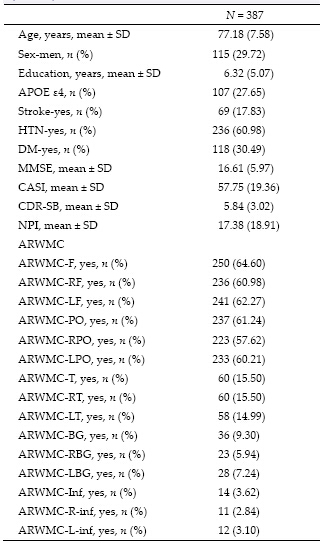
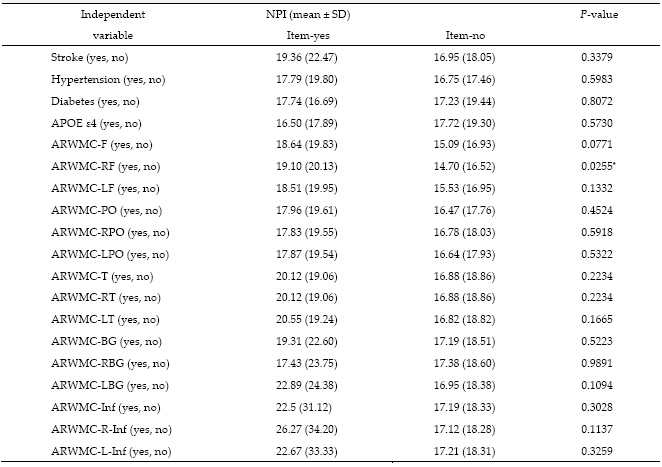
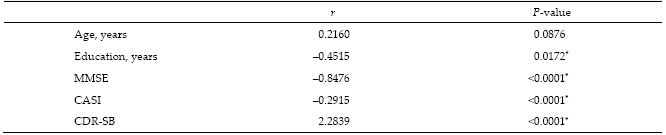
摘要 Objective: The frontal lobe may be involved in circuits associated with depression, apathy, aggression, and other psychiatric symptoms. Although white matter changes (WMC) are related to the severity of behavioral and psychological symptoms of dementia (BPSD) in patients with Alzheimer's disease (AD), it is unclear which part of the WMC may play the most important role in BPSD. This study was designed to investigate the relationship between the location of WMC and the severity of BPSD in AD patients. Methods: Among patients diagnosed with Alzheimer's disease between 2009 and 2014, 387 patients were retrospectively reviewed after those with pre-existing organic brain syndrome, psychiatric diseases, or toxic-metabolic encephalopathy were excluded. Patients' demographic and laboratory data, WMC measured with brain computed tomography and scored using the age-related white matter changes (ARWMC) scale, and neuropsychological tests, including the cognitive abilities screening instrument (CASI), the Mini-Mental State Examination (MMSE), the clinical dementia rating scale with sum-box (CDR-SB), and the neuropsychiatric inventory (NPI) were analyzed. Results: There was no significant difference in the NPI between patients with and without a history of stroke, hypertension, and diabetes. No significant difference in the NPI was identified between different sexes or different Apolipoprotein E (APOE) alleles. The NPI score was significantly correlated with the duration of education (r = -0.4515,P = 0.0172), CASI (r = -0.2915, P < 0.0001), MMSE (r = -0.8476, P < 0.0001), and CDR-SB (r = 2.2839, P < 0.0001). WMC in the right frontal lobe showed a significant difference in NPI in comparison to those without WMC (P = 0.0255). After adjusting for age, duration of education, and CASI, WMC in the right frontal lobe remained significantly associated with the NPI score (β = 3.8934,P = 0.042). Conclusions: WMC involving the right frontal lobe may play an important role in the BPSD in AD patients during their dementia diagnosis. Further studies are necessary to confirm whether controlling the risk factors of WMC can slow the progression of BPSD.
Abstract: Objective: The frontal lobe may be involved in circuits associated with depression, apathy, aggression, and other psychiatric symptoms. Although white matter changes (WMC) are related to the severity of behavioral and psychological symptoms of dementia (BPSD) in patients with Alzheimer's disease (AD), it is unclear which part of the WMC may play the most important role in BPSD. This study was designed to investigate the relationship between the location of WMC and the severity of BPSD in AD patients. Methods: Among patients diagnosed with Alzheimer's disease between 2009 and 2014, 387 patients were retrospectively reviewed after those with pre-existing organic brain syndrome, psychiatric diseases, or toxic-metabolic encephalopathy were excluded. Patients' demographic and laboratory data, WMC measured with brain computed tomography and scored using the age-related white matter changes (ARWMC) scale, and neuropsychological tests, including the cognitive abilities screening instrument (CASI), the Mini-Mental State Examination (MMSE), the clinical dementia rating scale with sum-box (CDR-SB), and the neuropsychiatric inventory (NPI) were analyzed. Results: There was no significant difference in the NPI between patients with and without a history of stroke, hypertension, and diabetes. No significant difference in the NPI was identified between different sexes or different Apolipoprotein E (APOE) alleles. The NPI score was significantly correlated with the duration of education (r = -0.4515,P = 0.0172), CASI (r = -0.2915, P < 0.0001), MMSE (r = -0.8476, P < 0.0001), and CDR-SB (r = 2.2839, P < 0.0001). WMC in the right frontal lobe showed a significant difference in NPI in comparison to those without WMC (P = 0.0255). After adjusting for age, duration of education, and CASI, WMC in the right frontal lobe remained significantly associated with the NPI score (β = 3.8934,P = 0.042). Conclusions: WMC involving the right frontal lobe may play an important role in the BPSD in AD patients during their dementia diagnosis. Further studies are necessary to confirm whether controlling the risk factors of WMC can slow the progression of BPSD.
Tzuchou Lin, Yihui Lin, Linli Kao, Yihui Kao, Yuanhan Yang, Pingsong Chou, Mengni Wu. An association between the location of white matter changes and the behavioral and psychological symptoms of dementia in Alzheimer's disease patients[J]. 临床转化神经科学, 2016, 2(1): 8-16.
Tzuchou Lin, Yihui Lin, Linli Kao, Yihui Kao, Yuanhan Yang, Pingsong Chou, Mengni Wu. An association between the location of white matter changes and the behavioral and psychological symptoms of dementia in Alzheimer's disease patients. Translational Neuroscience and Clinics, 2016, 2(1): 8-16.
[1] Evans DA, Funkenstein HH, Albert MS, Scherr PA, Cook NR, Chown MJ, Hebert LE, Hennekens CH, Taylor JO. Prevalence of Alzheimer's disease in a community population of older persons. JAMA 1989, 262(18): 2551-2556.
[2] Assal F, Cummings JL. Neuropsychiatric symptoms in the dementias. Curr Opin Neurol 2002, 15(4): 445-450.
[3] Zhao QF, Tan L, Wang HF, Jiang T, Tan MS, Tan L, Xu W, Li JQ, Wang J, Lai TJ, Yu JT. The prevalence of neuropsychiatric symptoms in Alzheimer's disease: Systematic review and meta-analysis. J Affect Disord 2016, 190: 264-271.
[4] Rapoport MJ, van Reekum R, Freedman M, Streiner D, Simard M, Clarke D, Cohen T, Conn D. Relationship of psychosis to aggression, apathy and function in dementia. Int J Geriatr Psychiatry 2001, 16(2): 123-130.
[5] Shin IS, Carter M, Masterman D, Fairbanks L, Cummings JL. Neuropsychiatric symptoms and quality of life in Alzheimer disease. Am J Geriatr Psychiatry 2005, 13(6): 469-474.
[6] Berger G, Bernhardt T, Weimer E, Peters J, Kratzsch T, Frolich L. Longitudinal study on the relationship between symptomatology of dementia and levels of subjective burden and depression among family caregivers in memory clinic patients. J Geriatr Psychiatry Neurol 2005, 18(3): 119-128.
[7] Steele C, Rovner B, Chase GA, Folstein M. Psychiatric symptoms and nursing home placement of patients with Alzheimer's disease. Am J Psychiatry 1990, 147(8): 1049-1051.
[8] Beeri MS, Werner P, Davidson M, Noy S. The cost of behavioral and psychological symptoms of dementia (BPSD) in community dwelling Alzheimer's disease patients. Int J Geriatr Psychiatry 2002, 17(5): 403-408.
[9] Breteler MMB, van Swieten JC, Bots ML, Grobbee DE, Claus JJ, van den Hout JHW, van Harskamp F, Tanghe HLJ, de Jong PTVM, van Gijn J, Hofman A. Cerebral white matter lesions, vascular risk factors, and cognitive function in a population-based study: The Rotterdam Study. Neurology 1994, 44(7): 1246-1252.
[10] Wahlund LO, Barkhof F, Fazekas F, Bronge L, Augustin M, Sjögren M, Wallin A, Ader H, Leys D, Pantoni L, Pasquier F, Erkinjuntti T, Scheltens P. A new rating scale for agerelated white matter changes applicable to MRI and CT. Stroke 2001, 32(6): 1318-1322.
[11] The LADIS Study Group. 2001-2011: A decade of the LADIS (leukoaraiosis and disability) study: What have we learned about white matter changes and small-vessel disease? Cerebrovasc Dis 2011, 32(6): 577-588.
[12] Lagopoulos J, Hermens DF, Hatton SN, Battisti RA, Tobias-Webb J, White D, Naismith SL, Scott EM, Ryder WJ, Bennett MR, Hickie IB. Microstructural white matter changes are correlated with the stage of psychiatric illness. Transl Psychiatry 2013, 3(4): e248.
[13] Kandiah N, Chander R, Zhang A, Yee CC. Cerebral white matter disease is independently associated with BPSD in Alzheimer's disease. J Neurol Sci 2014, 337(1-2): 162-166.
[14] Lee JJ, Lee EY, Lee SB, Park JH, Kim TH, Jeong HG, Kim JH, Han JW, Kim KW. Impact of white matter lesions on depression in the patients with Alzheimer's disease. Psychiatry Investig 2015, 12(4): 516-522.
[15] Li CH, Liu CK, Yang YH, Chou MC, Chen CH, Lai CL. Adjunct effect of music therapy on cognition in Alzheimer's disease in Taiwan: A pilot study. Neuropsychiatr Dis Treat 2015, 11: 291-296.
[16] Lin KN, Wang PN, Liu CY, Chen WT, Lee YC, Liu HC. Cutoff scores of the cognitive abilities screening instrument, Chinese version in screening of dementia. Dement Geriatr Cogn Disord 2002, 14(4): 176-182.
[17] Folstein MF, Folstein SE, McHugh PR. “Mini-mental state”. A practical method for grading the cognitive state of patients for the clinician. J Psychiatr Res 1975, 12(3): 189-198.
[18] Morris JC. The clinical dementia rating (CDR): Current version and scoring rules. Neurology 1993, 43(11): 2412-2414.
[19] Cummings JL. The neuropsychiatric inventory: Assessing psychopathology in dementia patients. Neurology 1997, 48(5 Suppl 6): S10-S16.
[20] Ball SL, Holland AJ, Watson PC, Huppert FA. Theoretical exploration of the neural bases of behavioural disinhibition, apathy and executive dysfunction in preclinical Alzheimer's disease in people with Down's syndrome: Potential involvement of multiple frontal-subcortical neuronal circuits. J Intellect Disabil Res 2010, 54(4): 320-336.
[21] Roth RM, Flashman LA, Saykin AJ, McAllister TW, Vidaver R. Apathy in schizophrenia: Reduced frontal lobe volume and neuropsychological deficits. Am J Psychiatry 2004, 161(1): 157-159.
[22] Lorenzetti V, Allen NB, Fornito A, Yücel M. Structural brain abnormalities in major depressive disorder: A selective review of recent MRI studies. J Affect Disord 2009, 117(1-2): 1-17.
[23] Shi YZ, Xiang YT, Wu SL, Zhang N, Zhou J, Bai Y, Wang S, Wang YL, Zhao XQ, Ungvari GS, Chiu HFK, Wang YJ, Wang CX. The relationship between frontal lobe lesions, course of post-stroke depression, and 1-year prognosis in patients with first-ever ischemic stroke. PloS one 2014, 9(7): e100456.
[24] Singh A, Black SE, Herrmann N, Leibovitch FS, Ebert PL, Lawrence J, Szalai JP. Functional and neuroanatomic correlations in poststroke depression: The sunny brook stroke study. Stroke 2000, 31(3): 637-644.
[25] Tang WK, Lu JY, Chen YK, Chu WC, Mok V, Ungvari GS, Wong KS. Association of frontal subcortical circuits infarcts in poststroke depression: A magnetic resonance imaging study of 591 Chinese patients with ischemic stroke. J Geriatr Psychiatry Neurol 2011, 24(1): 44-49.
[26] Drevets WC, Price JL, Furey ML. Brain structural and functional abnormalities in mood disorders: Implications for neurocircuitry models of depression. Brain Struct Funct 2008, 213(1-2): 93-118.
[27] Hirono N, Mega MS, Dinov ID, Mishkin F, Cummings JL. Left frontotemporal hypoperfusion is associated with aggression in patients with dementia. Arch Neurol 2000, 57(6): 861-866.
[28] Kumari V, Aasen I, Taylor P, Ffytche DH, Das M, Barkataki I, Goswami S, O'Connell P, Howlett M, Williams SCR, Sharma T. Neural dysfunction and violence in schizophrenia: An fMRI investigation. Schizophr Res 2006, 84(1): 144-164.
[29] Soyka M. Neurobiology of aggression and violence in schizophrenia. Schizophr Bull 2011, 37(5): 913-920.
[30] Tsujimoto M, Senda J, Ishihara T, Niimi Y, Kawai Y, Atsuta N, Watanabe H, Tanaka F, Naganawa S, Sobue G. Behavioral changes in early ALS correlate with voxel-based morphometry and diffusion tensor imaging. J Neurol Sci 2011, 307(1-2): 34-40.
[31] Rosen HJ, Allison SC, Schauer GF, Gorno-Tempini ML, Weiner MW, Miller BL. Neuroanatomical correlates of behavioural disorders in dementia. Brain 2005, 128(Pt 11): 2612-2625.
[32] Lee K, Shinbo M, Kanai H, Nagumo Y. Reduplicative paramnesia after a right frontal lesion. Cogn Behav Neurol 2011, 24(1): 35-39.
[33] Likitcharoen Y, Phanthumchinda K. Environmental reduplication in a patient with right middle cerebral artery occlusion. J Med Assoc Thai 2004, 87(12): 1526-1529.
[34] Perneczky R, Drzezga A, Boecker H, Wagenpfeil S, Förstl H, Kurz A, Häussermann P. Right prefrontal hypometabolism predicts delusions in dementia with Lewy bodies. Neurobiol Aging 2009, 30(9): 1420-1429.
[35] Devinsky O. Delusional misidentifications and duplications: Right brain lesions, left brain delusions. Neurology 2009, 72(1): 80-87.
[36] Xue HB, Xiao SF, Ng TP, Chen C, Meng GR, Lu XJ, Bu SM, Fang WL, Lv J, Zhang MY, McCabe MP. Prevalence and severity of behavioral and psychological symptoms of dementia (BPSD) in community dwelling Chinese: Findings from the Shanghai three districts study. Aging Ment Health 2013, 17(6): 748-752
[37] Ito T, Meguro K, Akanuma K, Meguro M, Lee E, Kasuya M, Ishii H, Mori E. Behavioral and psychological symptoms assessed with the BEHAVE-AD-FW are differentially associated with cognitive dysfunction in Alzheimer's disease. J Clin Neurosci 2007, 14(9): 850-855.
[38] Bandyopadhyay TK, Biswas A, Roy A, Guin DS, Gangopadhyay G, Sarkhel S, Ghoshal MK, Senapati AK. Neuropsychiatric profiles in patients with Alzheimer's disease and vascular dementia. Ann Indian Acad Neurol 2014, 17(3): 325-330.
[39] Gupta M, Dasgupta A, Khwaja GA, Chowdhury D, Patidar Y, Batra A. The profile of behavioral and psychological symptoms in vascular cognitive impairment with and without dementia. Ann Indian Acad Neurol 2013, 16(4): 599-602.
[40] Teodorczuk A, Firbank MJ, Pantoni L, Poggesi A, Erkinjuntti T, Wallin A, Wahlund LO, Scheltens P, Waldemar G, Schrotter G, Ferro JM, Chabriat H, Bazner H, Visser M, Inzitari D, O'Brien JT. Relationship between baseline whitematter changes and development of late-life depressive symptoms: 3-year results from the LADIS study. Psychol Med 2010, 40(4): 603-610.
 2016, Vol. 2